

Close
It usually starts with a promising email.
You shortlist a supplier in Morbi, India’s porcelain tile manufacturing hub. The FOB quote arrives at USD 6 to 9 per square metre, depending on tile size and finish. On paper, the margins look workable. You start planning retail pricing, allocating stock, and maybe even committing to a project timeline.
Then the freight forwarder calls.
Suddenly, the conversation is no longer just about tiles. It shifts to containers, port charges, rail connections, taxes, and delivery windows. The spreadsheet grows longer. The certainty starts to fade.
This is where many buyers realise that the cost of importing porcelain tiles from India to Canada has very little to do with the factory quote alone.
This guide walks you through the complete journey, from the factory gate in India to your warehouse in Canada, so you understand where the money actually goes and how to calculate a realistic landed cost per square metre.
At Wolf Porcelain, a leading porcelain tile exporter from India, we supply Canadian distributors, retailers, and project buyers across multiple formats. The breakdown below reflects how importing porcelain tiles into Canada actually works in 2026, based on real shipments, not theory.
FOB, or Free on Board, means the supplier’s responsibility ends once the container is loaded at the Indian port, most often Mundra near Morbi.
FOB pricing includes the tiles themselves, export-grade packaging, inland transport to the port, and export customs clearance in India. It does not include ocean freight, insurance, Canadian customs clearance, port handling, inland transport in Canada, or taxes.
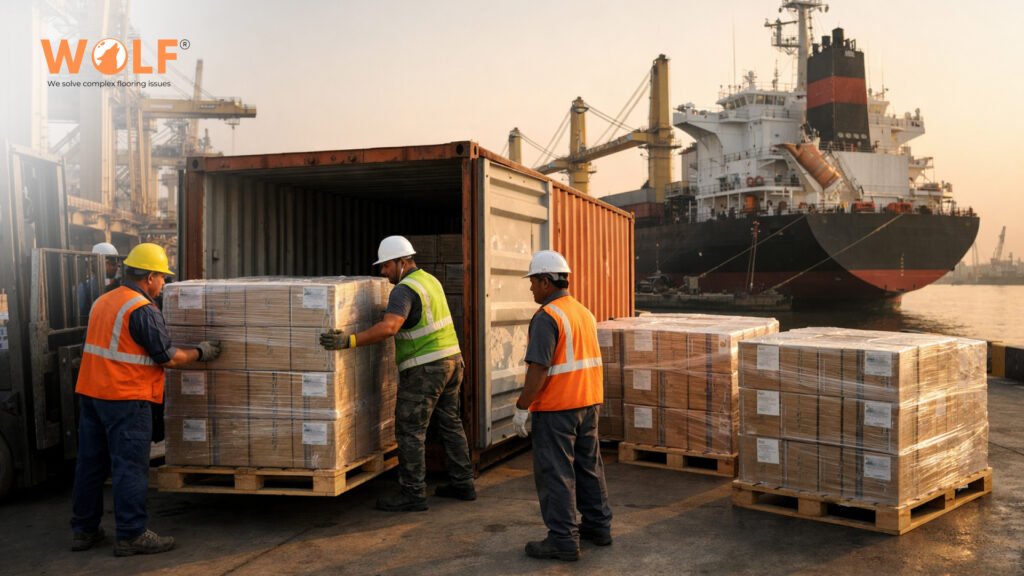
For most shipments, FOB pricing accounts for only 50 to 70 percent of the total landed cost. The remaining cost accumulates quietly after the container leaves India.
This is why per-box pricing is rarely useful for import planning. Without understanding pallet density, container utilisation, and freight exposure, a low factory price can still translate into a high landed cost. Serious importers evaluate porcelain tile import costs per square metre, fully landed.
Not all porcelain tiles ship the same way.
Tile size and surface finish influence more than factory pricing. They affect pallet density, packaging weight, breakage risk, and how many usable square metres fit inside a container. These factors directly impact freight cost per square metre when importing tiles from India to Canada.
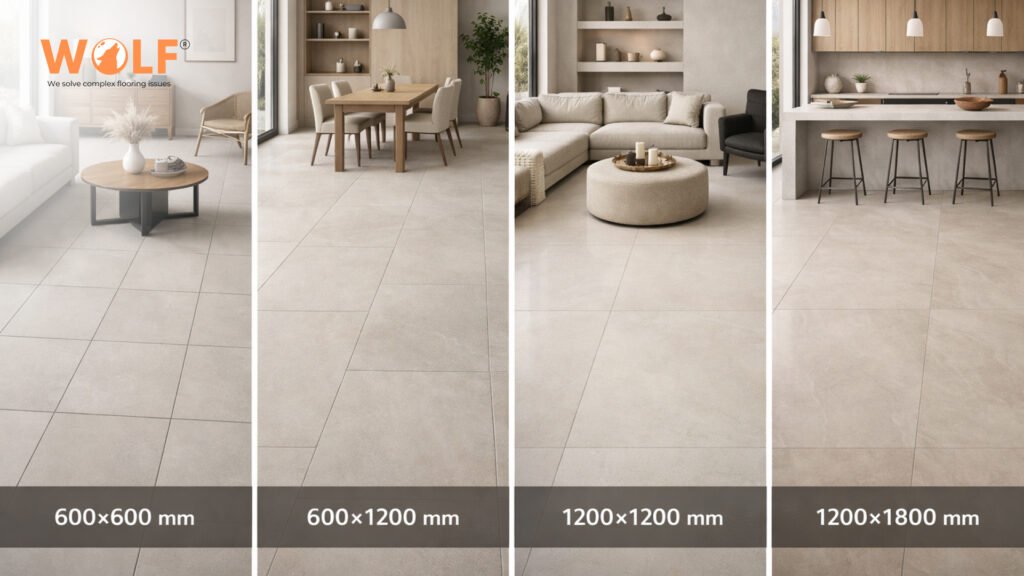
To understand how different formats behave in transit, you can view our porcelain tile collections across standard and large-format sizes. In real shipments, formats typically perform as follows:
24×24 (600×600 mm) The most freight-efficient format. High pallet density and minimal protective packing result in the lowest freight cost per square metre.
24×48 (600×1200 mm) One of the most commonly imported sizes when sourcing porcelain tiles from India to Canada. 600×1200 mm porcelain tiles balance design flexibility with predictable container efficiency.
32×64 (800×1600 mm) Popular in commercial interiors. Heavier pallets and reduced container fill begin to push landed cost per square metre higher.
48×48 (1200×1200 mm) This format requires protective interleaving. 1200×1200 mm large-format porcelain slabs occupy more vertical space, reducing total square metres per container.
48×72 (1200×1800 mm) A premium specification format. Highest FOB pricing and lowest container efficiency, typically chosen where aesthetics outweigh cost sensitivity.
Finish also plays a major role. Matte finishes set the baseline. Glossy finishes usually add a modest FOB premium. High-gloss or mirror-polished porcelain tiles require protective film and foam interleaving, which increases weight and reduces pallet density. As a result, freight cost per square metre rises sharply compared to matte finishes.
Ocean freight is the most volatile cost when importing porcelain tiles from India to Canada.
Most commercial shipments move as a 20-foot full container load, which carries approximately 1,393 square metres of 60×120cm tiles. The exact square metre capacity depends on tile format, pallet density, and packing method.
Common routing runs from Mundra Port in India into Vancouver, followed by intermodal rail to Toronto for eastern distribution.
Freight rates fluctuate with fuel costs, vessel availability, and seasonal demand. During peak shipping periods, freight can significantly affect your landed cost if not locked early. Buyers planning to import porcelain tiles from India to Canada for Q3 or Q4 demand are usually better positioned when freight is secured well in advance.
For a detailed look at documentation, booking, container loading, and transit stages, our guide on exporting porcelain tiles from India to Canada outlines the full process step by step.
This is often the least complicated part of the calculation.
Although India is not a CUSMA (Canada–United States–Mexico Agreement) partner, many porcelain tile classifications in Canada’s tariff schedule carry an 8 percent duty under the standard MFN (Most-Favoured-Nation) rate. In some cases, preferential treatment or exemptions may apply depending on the exact HS code and supporting documentation, which should always be confirmed with a licensed customs broker.
Taxes still apply.
Federal GST is charged at 5 percent, while provincial HST or PST applies based on the destination province. Brokerage fees are relatively small compared to freight and inland transport, but they are unavoidable and should be budgeted per container.
Anti-dumping rules exist to protect domestic manufacturers when imported goods are sold at unfairly low prices. In Canada, this process is governed under SIMA, where a local producer can request an investigation if they believe imports are harming the market.
While other countries have imposed anti-dumping duties on tile imports, Canada does not currently have such orders in place on porcelain tiles originating from India. As of early 2026, Indian-origin porcelain tiles are not subject to any active anti-dumping duties at the Canadian border.
For importers, this is largely a background check rather than a pricing risk. Anti-dumping measures, when they apply, are public, product-specific, and enforced consistently. They do not appear unexpectedly after a shipment is already on the water.
Verification is straightforward. Before placing a large or first-time order, your Canadian customs broker can confirm whether the HS code and country of origin fall under any current SIMA measures. This typically takes minutes, not weeks, and requires no special documentation from the supplier beyond standard commercial invoices.
In practical terms, for most Canadian distributors and project buyers importing standard porcelain tiles from India, anti-dumping is not a deciding factor in supplier selection or landed cost planning today. It’s simply a box to check during due diligence, not a variable that complicates everyday importing.
Clearing customs is not the end of the journey.
Once your container arrives, you will incur terminal handling charges, local drayage, possible inspections, and inland freight to your warehouse or distribution centre. For shipments moving beyond the port city, intermodal rail becomes a major but predictable cost.
Our export coordination process helps importers avoid documentation errors and delays that can trigger inspections or storage charges at Canadian ports.
The calculation itself is simple. Using the right inputs is where most importers struggle.
Your landed cost per square metre should include FOB cost, ocean freight, insurance, port handling, inland transport, brokerage fees, applicable taxes, and a realistic breakage allowance.
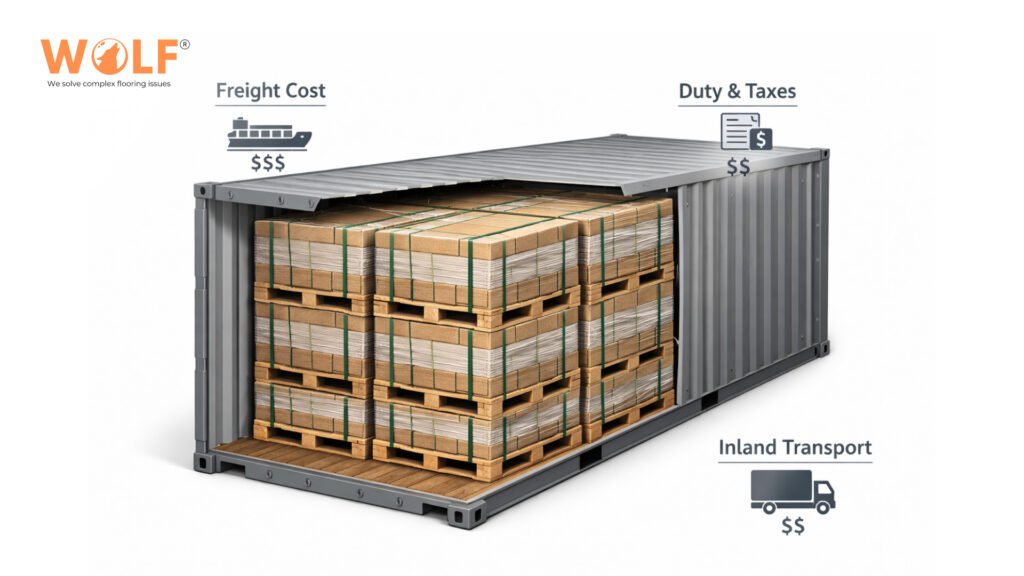
Common mistakes include planning margins based only on FOB pricing, ignoring container efficiency differences between tile formats, forgetting that freight is charged per container rather than per tile, and underestimating breakage on large-format porcelain slabs.
In practice, FOB prices for porcelain tiles from India typically range from USD 4 to 4.50 per square metre. Once fully landed in Canada, including freight, port handling, duties, and taxes, the total cost generally comes to CAD 8.50 to 9.50 per square metre.
By the time most buyers reach this stage, the question is no longer whether importing from India makes sense. It’s how to do it without cost surprises after the container ships.
This is where an experienced exporter adds real value.
At Wolf Porcelain, we work with Canadian importers, distributors, and project buyers who are navigating the same variables outlined above: format selection, container utilisation, freight planning, and landed cost accuracy. Our role goes beyond supplying tiles. We help buyers understand how product decisions made at the quotation stage translate into real costs once those tiles arrive in Canada.
Because we regularly ship porcelain tiles on this trade lane, pricing discussions are framed around container-level realities, not just factory rates. That includes advising on format combinations that optimise square metres per FCL, identifying finishes that require additional protective packing, and aligning production schedules with realistic shipping windows.
For bulk and repeat buyers, this approach reduces uncertainty. Instead of calculating landed costs after the order is placed, you can evaluate them before production begins and capital is committed.
If you’re at the stage where numbers need to be precise, you can request a custom price quote for your container order and assess your landed cost with clarity before moving forward.
FOB pricing for porcelain tiles from India typically runs USD 4 to 4.50 per square metre. Once fully landed in Canada, including freight, port handling, duties, and taxes, Canadian importers can expect a total landed cost of CAD 8.50 to 9.50 per square metre
Smaller formats such as 24×24 and 24×48 maximise container utilisation and minimise freight cost per square metre. Large-format porcelain tiles trade efficiency for design impact.
Ocean transit from Mundra Port to Vancouver typically takes 35 to 40 days. Rail transfer to Toronto adds approximately one week, with customs clearance typically taking a few additional days.
As of early 2026, no active anti-dumping measures apply to India-origin porcelain tiles. Importers should confirm the current status with a customs broker before ordering.
A 20-foot container holding approximately 1,393 square metres of 60×120cm tiles is generally considered the most practical starting point for commercial imports. It provides a balance between freight efficiency and manageable inventory exposure for Canadian distributors and project buyers.
Importers in Canada must work with a licensed customs broker to clear goods through the Canada Border Services Agency. whether arriving at Vancouver, Montreal, or other Canadian ports from Mundra Port, India Your broker prepares the documentation, submits the tariff classification, calculates GST/HST, and coordinates release at the port.
High-gloss finishes require protective film and foam interleaving, adding weight and reducing pallet density. Fewer square metres fit per container, which raises freight cost per sqm on top of the FOB premium, making high-gloss the most expensive finish to import at scale.