
Close
You’ve invested in your space. The lighting is right, the display tiles are well chosen, the staff knows the product. A customer walks in, browses for twenty minutes, then pulls out their phone and finds the same tile cheaper online.
Sound familiar?
The problem isn’t your showroom. It’s that the product on your floor is available everywhere, same supplier, same range, same name on the box. When anything can be found and price-compared in thirty seconds, the showroom stops being an advantage.
The retailers breaking out of this cycle in 2026 aren’t switching suppliers. They’re switching strategies, building private label tile collections that carry their own brand, their own curation, and no direct comparables. And they’re doing it through OEM partnerships with private label porcelain tile manufacturers in India, where the production capability and export infrastructure to make this viable already exists.
This guide explains how the process works, what it costs to get started, and why the Dutch market is particularly well suited to benefit from it.
Dutch interior preferences have shifted decisively. Compact urban homes in Dutch cities demand tiles that do more with less, visually expand spaces, reduce visual clutter, and complement minimalist furniture. The consumer knows what they want: clean lines, muted palettes, and formats that make a 12-square-metre bathroom feel considered rather than cramped.
What the consumer doesn’t know or care about is which factory made the tile. What they respond to is the brand presenting it.
This is the opportunity. A Dutch retailer who owns a private label collection owns the conversation in their showroom. They’re not explaining why their 60×120 looks the same as the one down the street. They’re presenting their range, their curation, their design point of view.
India has become one of the world’s most capable sources for OEM porcelain tile manufacturers for export, and the reason is concentrated in one place: Morbi, Gujarat.
Custom tile manufacturing in Morbi operates at a scale and technical level that matches European production standards while maintaining cost structures that make private labelling economically viable for mid-sized retailers. Factories here run large-format presses, digital printing lines, and surface treatment systems that can produce matte, glossy, and high-gloss finishes with the kind of consistency that export-grade programs require. Leading export-focused manufacturers in Morbi produce porcelain tiles that comply with EN 14411, the European standard for porcelain tiles, and carry CE marking for EU market entry. This includes meeting water absorption standards below 0.5% under EN ISO 10545, a baseline requirement that serious OEM partners treat as non-negotiable.
Critically, the region’s export infrastructure is mature. Tile exporters in India to the Netherlands understand EU documentation requirements, container packing standards, and the port-to-port timeline that European buyers plan around. The region has over a decade of export maturity and established EU trade experience.
The term “private label” can sound complicated. In practice, it follows a straightforward sequence. Here’s what the journey looks like for a Dutch retailer starting from scratch.
This is where you make the decisions that matter most, tile size, surface finish, and design direction. Are you building a matte collection for compact Dutch bathrooms? A large-format glossy range for open-plan living?
Your choices here determine everything downstream, from production to positioning.
Working with wholesale tile manufacturers in Morbi, retailers can request specific tone adjustments, texture variations, and surface sheen levels. Minimalist concrete looks, soft stone finishes, and tonal neutrals in beige, grey, and off-white are particularly well suited to Dutch interiors and are producible within standard OEM programs.
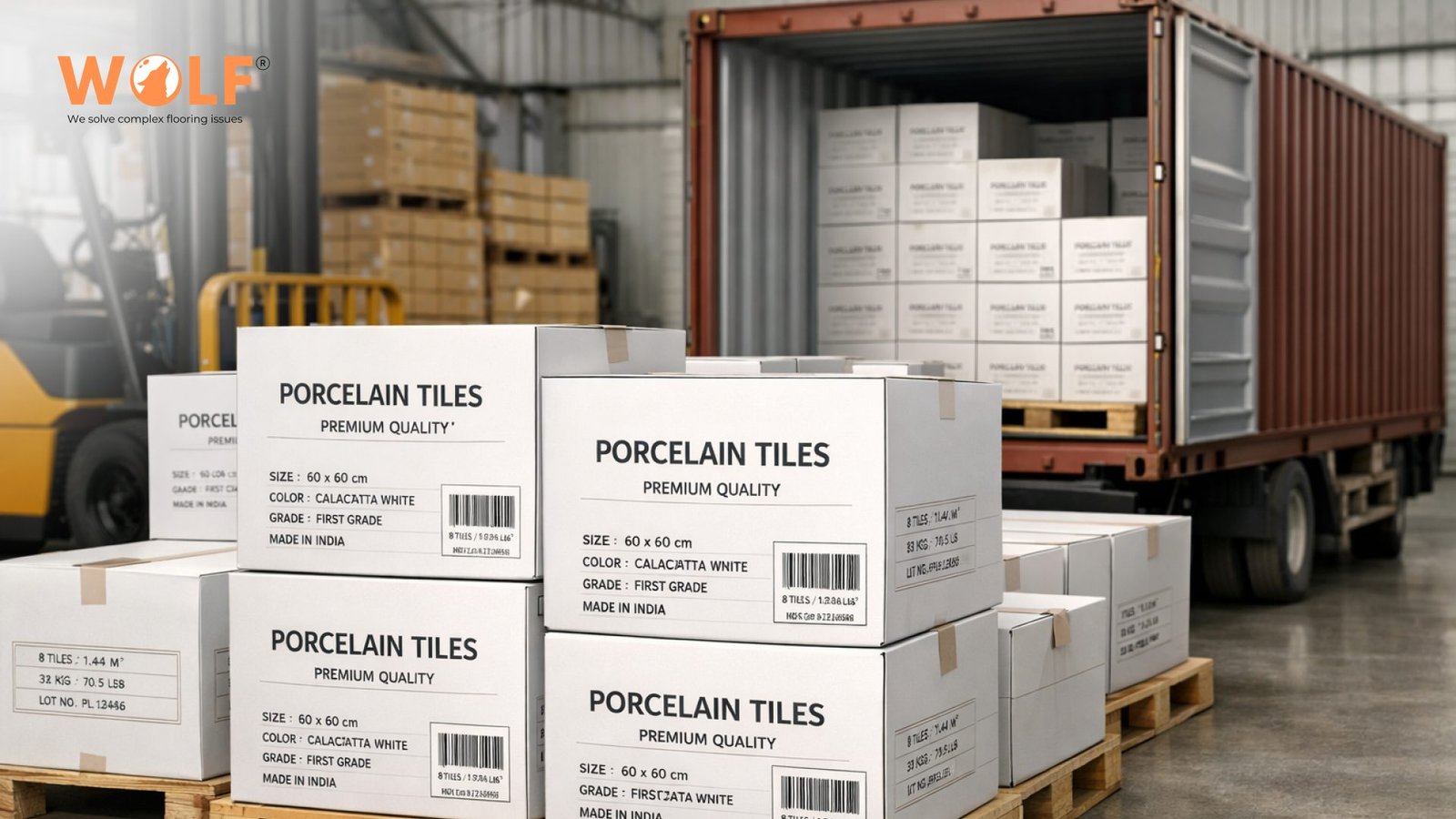
This is where the product becomes yours. OEM programs allow retailers to specify carton design, logo placement, barcode formatting, and labelling aligned with Dutch retail and logistics systems. The same tile that leaves the factory as a standard product arrives at your warehouse as your brand.
Minimum order quantities are typically structured around container loads, the most cost-efficient unit for export. Quantities vary by size and finish, but most private label programs are accessible to retailers operating at a serious commercial scale without requiring industrial-volume commitments from day one.
Before dispatch, OEM orders go through batch inspection, shade consistency checks, and packaging verification. This is non-negotiable for private labels, where inconsistency between batches damages your brand reputation, not the factory’s.
A manufacturer experienced in global logistics manages container loading, packing documentation, and shipping coordination. How we export to 40+ countries worldwide gives retailers a clear picture of what structured export handling looks like at scale, from loading protocols to transit documentation.
Format selection is one of the most important decisions in building a private label collection. For the Dutch market, two sizes consistently outperform others in both residential and commercial applications.
This is the format built for compact Dutch homes. Fewer grout lines mean a cleaner visual field. The elongated proportion creates a sense of continuity that makes bathrooms, kitchens, and corridors read as larger than they are. Applied vertically on walls, it adds ceiling height. Used horizontally on floors, it draws the eye outward.
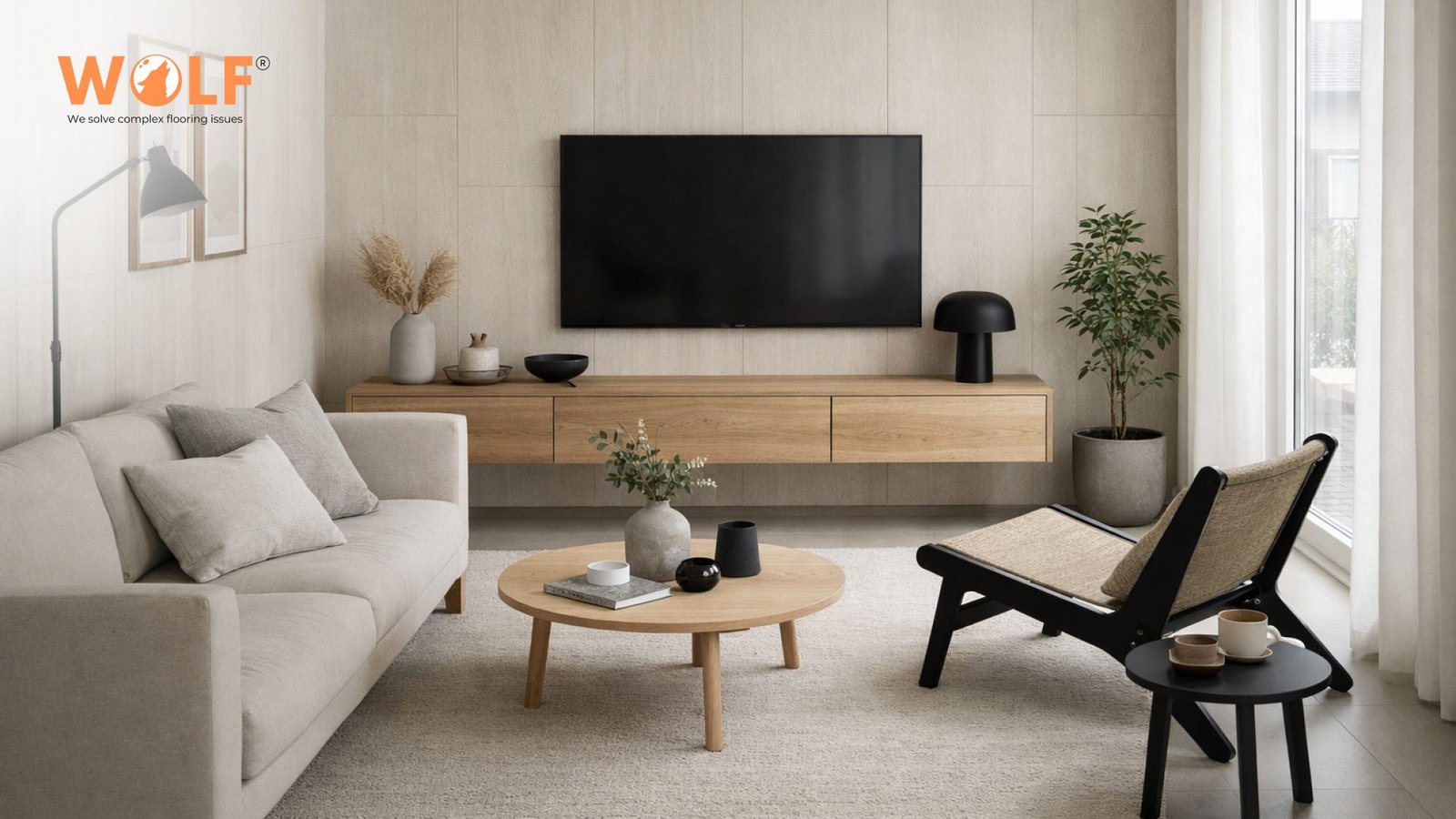
For Dutch retailers building a private label range around the small-space trend, this is the anchor format. Retailers looking to develop this category can explore our 600×1200mm tile designs for a reference point on how the format translates across different finishes and surface textures.
Matte finishes in neutral tones are the natural pairing, understated, practical, and aligned with how Dutch consumers currently furnish their homes.
For retailers targeting the higher end of the market, open-plan living spaces, luxury bathrooms, design-forward showroom displays, the 1200×1200mm format delivers a seamlessness that smaller tiles simply cannot replicate.
The reduced grout grid creates what interior designers describe as a “poured floor” effect. In high-gloss finishes, it reflects light across the room and amplifies perceived space. In matte, it grounds the room with a quiet authority.
Large-format 1200×1200mm porcelain slabs work particularly well as showroom centrepieces, the kind of product that stops a browser and starts a conversation.
Surface finish is not just an aesthetic choice, it’s a market positioning decision.
Matte finishes currently align strongly with Dutch residential design preferences. It reads as contemporary without being cold, practical without being institutional. It handles the light in north-facing rooms gracefully. It’s the finish that works in a minimalist kitchen without demanding attention, and in a bathroom without showing every water mark. For private label collections targeting the residential mainstream, matte is the foundation.
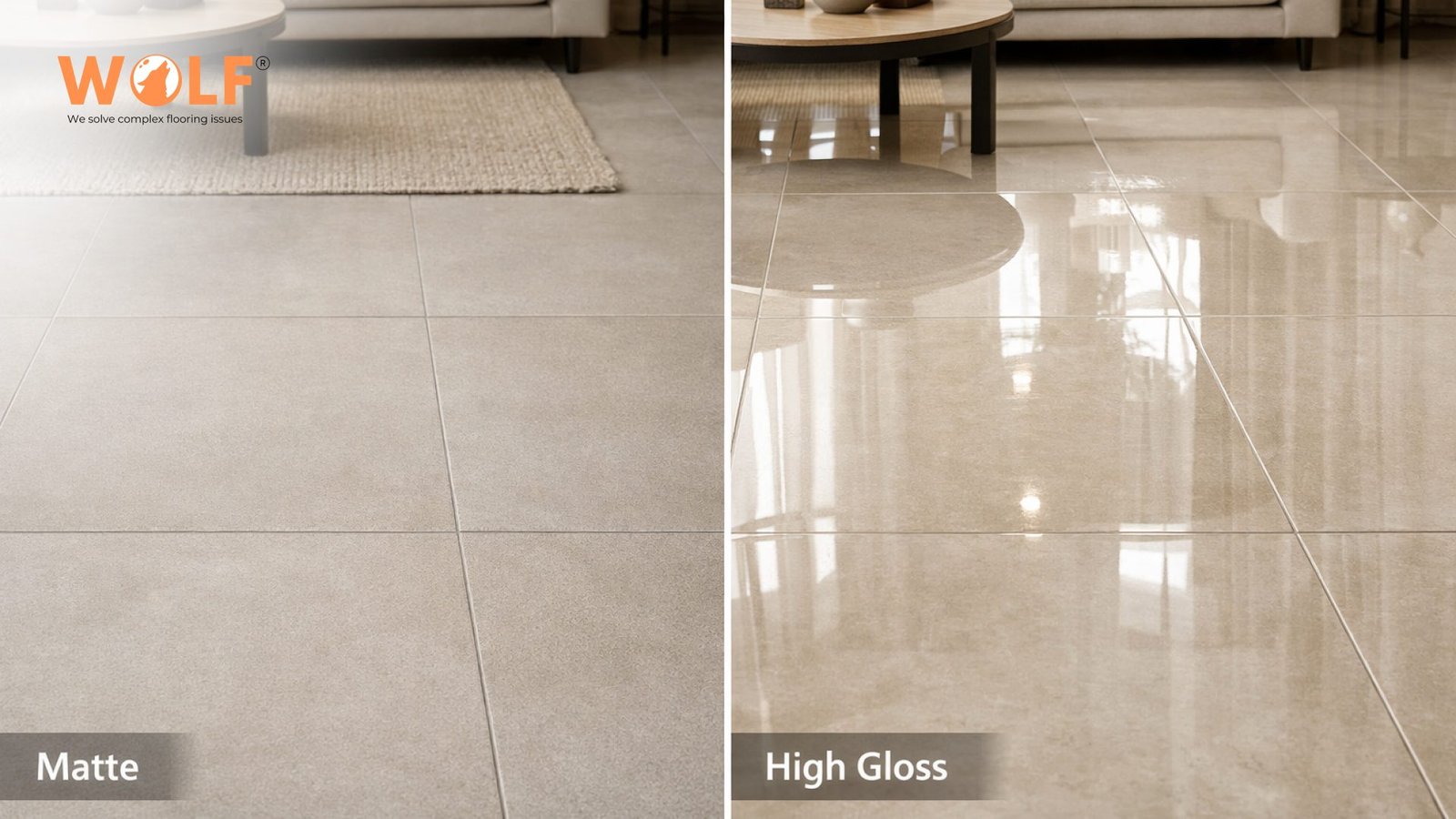
High Gloss Finishes serves a different purpose. It amplifies light, creates drama, and suits spaces where the tile is meant to be noticed, feature walls, luxury wet rooms, statement retail environments. For retailers building a premium tier within their private label range, high glossy creates clear visual differentiation on the showroom floor without requiring an entirely separate collection.
The strongest private label strategies combine both: matte as the volume driver, high glossy as the premium statement.
The financial logic of private labelling is straightforward, but it’s worth making explicit.
When you resell branded tiles, the supplier’s margin is already baked into your cost price. When you own the private label, you control the brand premium. The same tile, presented as part of a curated collection under your own name, commands a higher retail price than a generic equivalent because the customer is buying into your curation, not just a commodity.
Beyond margin, private labels build something resellers cannot: repeat purchase loyalty. A customer who loves your collection comes back to you, not to a supplier’s catalogue.
To make this concrete: a Dutch retailer operating three showrooms launching a 12-SKU matte collection could start with two containers, one covering the 600×1200mm format for residential bathrooms and kitchens, one covering the 1200×1200mm format for open-plan flooring. That’s a defined, manageable entry point. The brand is established. The collection is exclusive. And every subsequent reorder builds on the first.
The upfront investment, design choices, MOQ commitment, packaging setup, is a one-time cost that pays forward across every subsequent order.
Not every factory in Morbi is equipped for private label programs. The distinction matters because OEM production requires more than manufacturing capability, it requires communication reliability, branding flexibility, and the kind of production consistency that holds across multiple container orders over time.
The risks of choosing the wrong partner are specific and real. Shade variation between batches is the most common issue, tiles from a repeat order that don’t match the first container create returns and showroom credibility problems that land on your brand, not the factory’s. Batch inconsistency in finish quality, communication delays that misalign production with your seasonal buying windows, and packaging errors that trigger CBSA or EU customs examinations are all documented problems with suppliers who treat OEM as a secondary service rather than a core capability.
Working with a porcelain tile manufacturer in India with 20+ years of experience provides retailers with something that newer operations cannot offer: a proven track record across markets, finishes, and order scales. Long-term export relationships are built on production reliability, not just competitive pricing.
Production capacity also matters when your brand starts gaining traction. Our 5 state-of-the-art production lines mean that a private label program can scale from initial container orders to repeat supply without the bottlenecks that limit smaller operations.
A private label program means a manufacturer produces tiles that are branded, packaged, and labelled under your company's name. You choose the size, finish, and design direction. The factory handles production and export. The finished product arrives at your warehouse as your brand, ready for your showroom or retail channel.
Indian manufacturers, particularly in Morbi, offer a combination of production scale, design flexibility, and export maturity that few regions match. They understand EU documentation requirements, produce to consistent quality standards, and offer OEM programs structured around container-level economics that make private labelling viable for serious retailers.
Dutch tile retailers, showroom owners, and brand builders who want to differentiate their offering, improve margins, and build customer loyalty beyond price competition. It suits retailers who have an established customer base and want to deepen it with exclusive collections rather than competing on standard catalogue products.
The 24×48 (600×1200mm) format performs strongly in compact Dutch residential spaces like bathrooms, kitchens, and corridors where its elongated proportion reduces grout lines and visually expands the room. The 48×48 (1200×1200mm) format suits premium open-plan spaces and showroom display, delivering a seamless, design-forward aesthetic.
Production timelines depend on order volume, finish complexity, and customisation level. Ocean transit from Mundra Port toThe Netherlands generally ranges between 25 and 35 days depending on carrier schedules. Total lead time from order confirmation to warehouse delivery, including production, quality checks, and shipping, generally ranges from 60 to 90 days for a first container.
A 20-foot container holds approximately 1,393 square metres for 60×120cm tiles and is the most cost-effective starting point for Dutch retailers entering a private label program. MOQs are structured around this unit, making the entry point commercially accessible without requiring large capital commitments upfront.
Dutch interiors lean toward understated, functional aesthetics, minimalist furniture, neutral palettes, and clean spatial compositions. Matte finishes complement this direction without demanding attention. They handle northern light conditions gracefully, work across wet and dry applications, and align with the Scandinavian-influenced design language that resonates strongly with Dutch consumer preferences.
The Dutch tile market is not short of product. It is short of differentiation. Retailers who build exclusive collections strengthen their position in showroom conversations and reduce dependence on price as the primary selling point.
Retailers preparing collections for the 2026-2027 season should begin OEM planning 3-4 months in advance to align production slots, packaging lead times, and shipping windows. The earlier the brief is placed, the more control you have over the outcome.
The manufacturing capability to make that happen exists in India, and the process is more accessible than most retailers assume.
Start a private label partnership with Wolf, inquire about OEM and private label programs for the Dutch market today.