

Close
Poland’s residential construction market has expanded rapidly over the past decade, particularly in cities like Warsaw, Kraków, Wrocłsizeaw, and Gdańsk. New apartment developments are being built at scale, and procurement teams are responsible for sourcing materials that remain consistent across hundreds of units and multiple project phases simultaneously.
Tiles are one of the highest-volume line items in any residential build. Get the sourcing right and you control a significant portion of your material budget. Get it wrong and you face delays, shade mismatches between project phases, and cost overruns that compress already tight margins.
Many Polish procurement teams are now sourcing factory price tiles from Morbi manufacturers to control project costs across large residential developments. Not through intermediaries. Not through European distributors marking up imported stock. Direct from the factory floor.
Wolf Porcelain Tiles is part of Wolf Group, a porcelain tile manufacturer in Morbi, India with more than two decades of experience exporting to international construction markets.
This guide explains how the sourcing model works, what procurement teams need to plan for, and why direct factory supply from Morbi makes practical sense for Polish construction at scale.
Morbi, located in Gujarat on India’s western coast, has grown over several decades into one of the most concentrated ceramic and porcelain production clusters in the world, with hundreds of factories operating across the region.
What makes Morbi specifically relevant for Polish buyers is not just scale. It is the combination of production capacity, export infrastructure, and the design investment that porcelain tile manufacturers in Morbi exporting worldwide have made to serve European markets specifically.
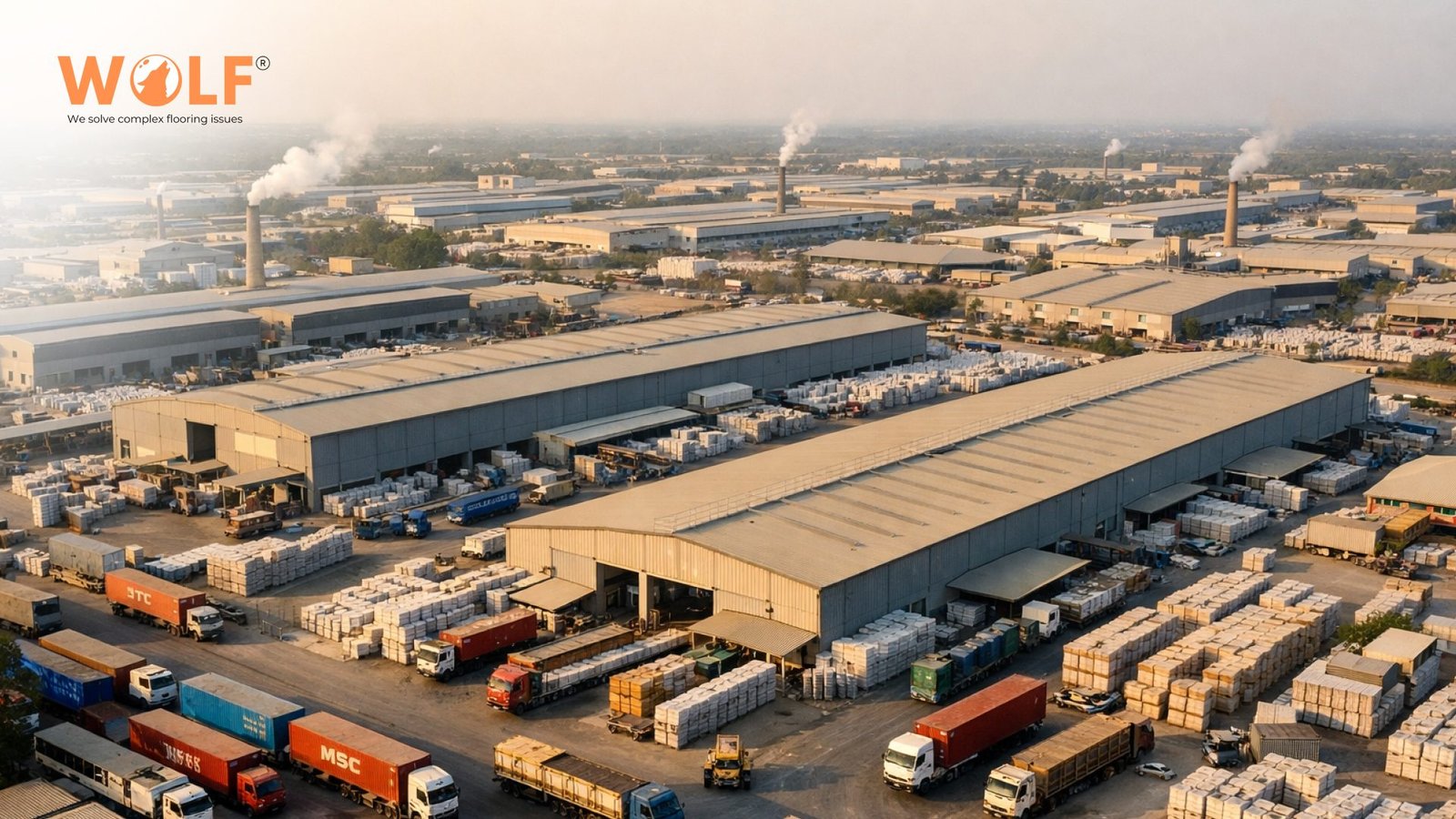
Polish residential developers often require the same tile design across dozens of apartments or multiple building phases. Morbi factories operate continuous production lines capable of handling millions of square metres monthly. This means a manufacturer can reserve batch production for a project, ensuring consistent shade and dimensional accuracy across deliveries spread over months.
Morbi tile manufacturers exporting to Europe have invested in packaging formats, pallet dimensions, and documentation systems that align with European import requirements. Polish customs clearance, CE documentation, and pallet specifications are not afterthoughts. Reputable manufacturers exporting to Europe also supply EN 14411 test documentation confirming key performance parameters such as water absorption ≤0.5% for porcelain tiles, flexural strength, abrasion resistance classification (PEI), and slip resistance ratings depending on the surface finish.
They are built into the export process from the start.
Raw materials, kiln equipment, packaging suppliers, and logistics providers are all concentrated within the Morbi cluster. This proximity reduces production costs in ways that are structurally difficult for European manufacturers to replicate, and those savings pass through directly to factory pricing.
For Polish procurement teams, this means access to a supply source that combines genuine manufacturing scale with export experience specifically oriented toward European construction markets. For design preferences shaping current demand in Poland, see our guide to porcelain tile styles trending in Polish homes.
The pricing difference between factory direct sourcing and buying through European distribution channels is structural.
A standard European tile supply chain typically moves through an importer, a regional distributor, and a local wholesaler before reaching a construction company. Each stage adds margin. By the time tiles reach a Polish developer through traditional channels, the factory price may have been marked up through three or four intermediaries.
Polish buyers sourcing factory-price porcelain tiles from Morbi can access manufacturer pricing directly, negotiated on volume rather than on whatever a distributor has decided the market will bear.
For large residential projects this creates real budget impact. A development requiring 50,000 square metres of porcelain flooring is a fundamentally different conversation at factory price than at distributor price. The savings are meaningful enough to affect project viability and competitive tendering.
Direct sourcing also provides pricing stability across project phases. Distributors adjust pricing based on their own stock levels and market conditions. Manufacturers can agree fixed pricing for project volumes committed in advance, giving procurement teams cost certainty that is genuinely difficult to achieve through traditional channels.
For procurement teams managing large residential developments, the relationship between order volume and cost per square metre is one of the most important levers available.
Morbi tile manufacturers for bulk orders structure pricing in volume tiers. The more square metres committed upfront, the lower the unit cost. For a developer tiling 200 apartments, the difference between ordering in phases through a distributor and committing full project volume directly with a manufacturer can represent substantial savings across the total material budget.
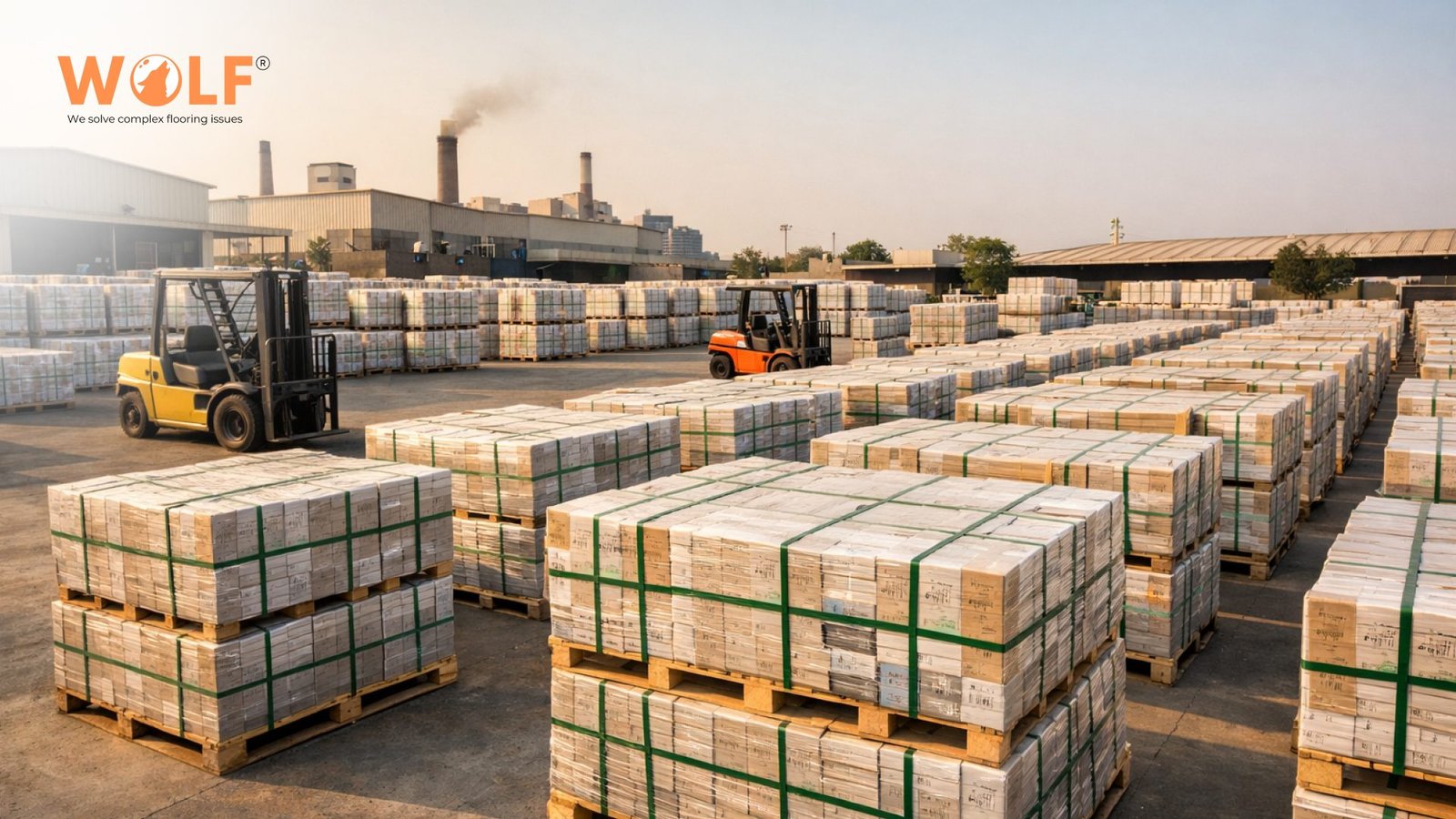
Container optimization compounds this further. Shipping costs are calculated per container, not per tile. Manufacturers experienced in export plan pallet dimensions and stacking configurations to maximize container utilization. A well-optimized container reduces the landed freight cost per square metre, keeping overall procurement costs competitive even after ocean freight and import duties are factored into the total landed cost calculation.
For procurement teams evaluating total landed cost rather than just product price, the combination of bulk pricing and container optimization is where the real financial advantage of direct factory sourcing becomes clear.
Export shipments for construction projects are typically planned around 20-foot containers, which offer the most cost-efficient shipping configuration for porcelain tiles.
For example, a 20-ft container can carry approximately 1300 – 1400 square metres of 60×120 cm porcelain tiles, depending on pallet configuration and packaging structure. Because this format is widely used in global construction projects, it allows procurement teams to plan quantities accurately while maintaining efficient container utilization.
The logistics of importing tiles from India to Poland are more straightforward than they might initially appear. Porcelain tile manufacturers in Morbi for export manage international container shipping regularly and most have established freight partnerships covering the India-to-Poland corridor.
Most shipments leave India through Mundra Port in Gujarat, the primary export gateway used by Morbi tile manufacturers for international shipments. Because Mundra sits close to the Morbi manufacturing cluster, it allows efficient container movement from factory to port before ocean freight to European destinations such as Gdańsk and Gdynia in Poland or other major European ports.
From Mundra, containers travel by ocean freight to European ports. For Polish importers the most practical arrival points are Gdańsk and Gdynia, both of which have established import handling for construction materials.
Transit time from factory to Polish port typically runs between four and six weeks. Procurement teams should factor this into project scheduling, particularly when coordinating tile deliveries with installation phases on active construction sites.
Experienced exporters provide a complete documentation package with every container. This includes commercial invoices, packing lists, certificates of origin, and compliance documentation required for Polish customs clearance. For buyers requiring CE marking documentation and EN 14411 test reports, reputable manufacturers provide these as standard. To understand how containers are prepared, documented, and shipped to European ports, review our export and shipping process.
Morbi manufacturers supplying Polish projects already produce the sizes most commonly specified for residential construction, in both the standard apartment format and the large-format preferred in modern open-plan developments.
The 600×600mm format is the most widely specified size across Polish apartment developments. It works across kitchens, bathrooms, hallways, and living areas, and its proportions suit the room sizes typical in Polish residential construction. Installation is efficient, material waste is manageable, and the format maintains design consistency when the same tile runs across multiple rooms or units. Explore our 600×600mm porcelain floor tiles for designs suited to both matte and glossy specifications common in Polish residential interiors.
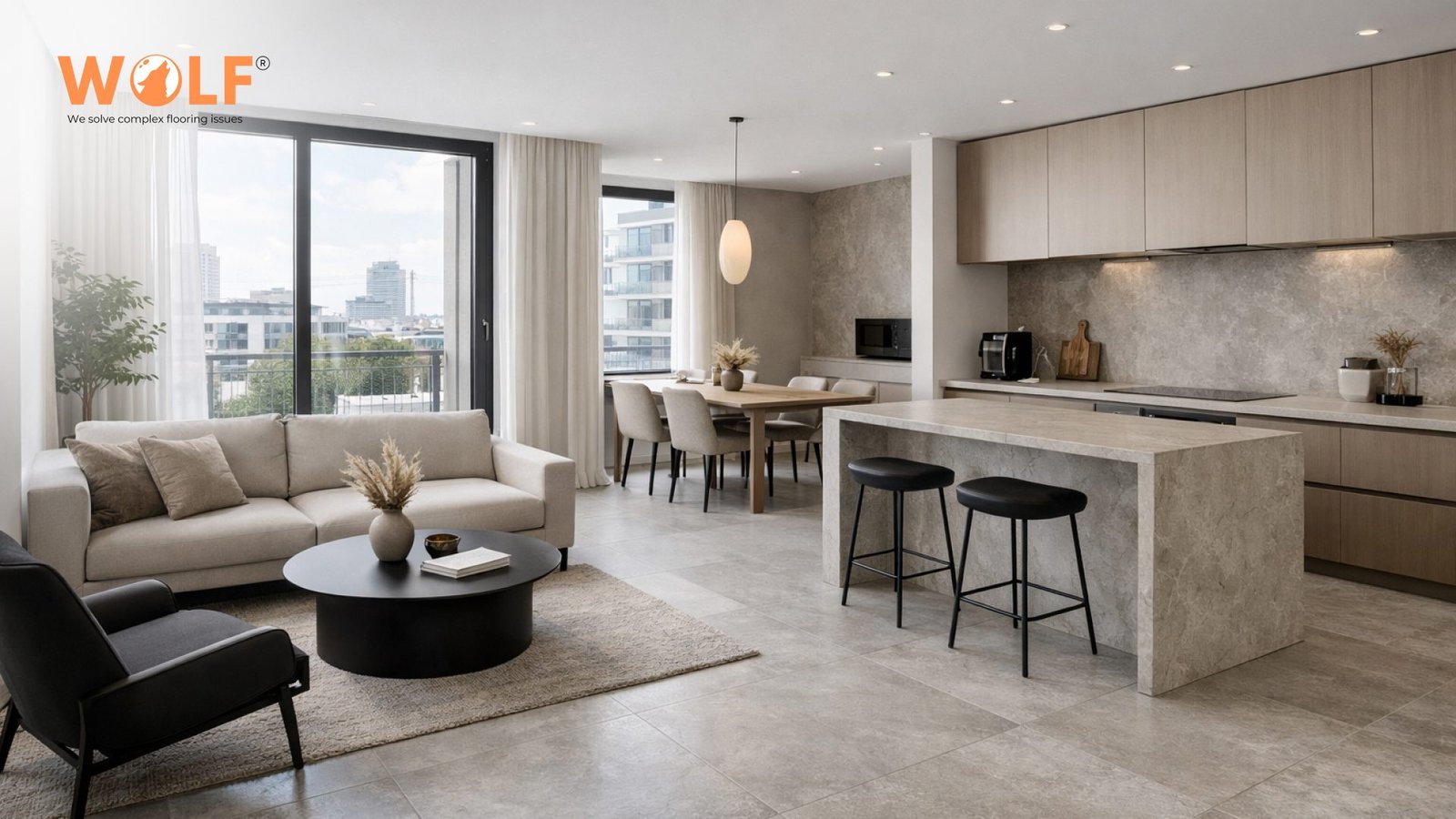
Large-format porcelain tiles are becoming increasingly popular in Polish residential developments, particularly in open-plan living areas where developers aim to create a spacious, modern aesthetic. The 1200×1200mm format significantly reduces grout lines compared to smaller formats, creating a cleaner and more continuous floor surface. This is especially valuable in modern Polish apartments where kitchens, dining spaces, and living rooms are often integrated into a single open layout. Beyond aesthetics, larger tiles also improve installation efficiency across large areas and deliver a premium finish that appeals to buyers in mid- to upper-tier residential developments. Explore our 1200×1200mm large-format porcelain tiles designed for modern residential construction.
Matte finishes are more commonly specified for Polish residential floors because they support safer underfoot performance, reduce visible wear in high-traffic areas, and align well with the contemporary low-gloss interior schemes that dominate modern Polish apartment design. For procurement teams specifying across multiple units, matte finishes also offer consistent performance in kitchens, bathrooms, and hallways without requiring finish-specific installation considerations.
Glossy finishes are typically more suitable for wall applications or lower-risk interior zones where reflectivity and brightness are prioritized over slip performance. In smaller Polish apartments, glossy surfaces are often specified to amplify natural light and create a perception of additional space. Many Polish developers pair glossy wall tiles with matte floor tiles to balance the visual benefit of reflection with the practical safety requirements of floor surfaces.
Understanding which finish suits which application helps procurement teams specify correctly the first time, avoiding costly substitutions mid-project.
Sourcing internationally for a large construction project involves more than finding a competitive price. It requires confidence that supply will arrive on time, match what was specified, and remain consistent across multiple deliveries spanning months.
This is where porcelain tile manufacturers in Morbi for export with genuine quality systems distinguish themselves from lower-tier suppliers in the same region.
Batch consistency is the critical issue for multi-phase residential projects. A developer tiling 200 apartments cannot afford visible shade variation between floors installed in month three and floors installed in month seven. ISO-certified manufacturers address this through documented production processes, color measurement systems, and batch traceability that links every pallet to its production parameters.
For Polish procurement teams evaluating suppliers, requesting ISO 9001 certification, EN 14411 test reports, and CE documentation is the starting point. These documents help procurement teams verify product consistency, conformity with export requirements, and suitability for use in regulated project environments. Manufacturers with genuine export experience expect these requests and provide complete documentation packages as standard.
The combination of manufacturing scale, export experience, and direct factory pricing makes Morbi a competitive sourcing option for large residential projects. Polish developers working on multi-unit developments can negotiate directly with manufacturers, access consistent batch production, and achieve landed costs that European distributors cannot match at equivalent quality levels.
Manufacturers price based on volume commitments. Polish buyers specifying tile quantities for a full project phase can negotiate fixed pricing that remains stable across deliveries. This removes the pricing variability that comes with sourcing through distributors who adjust margins based on their own stock conditions.
For projects delivered in stages, procurement teams should confirm batch reservation, dispatch scheduling, and documentation timelines before production begins. This reduces the risk of shade variation, delayed replenishment, or last-minute substitutions between phases. Establishing these parameters with the manufacturer before the first order is placed protects the entire project timeline, not just the initial delivery.
The 600×600mm format is the standard across most Polish apartment developments. The 1200×1200mm format is increasingly specified in modern open-plan spaces and premium residential projects where fewer grout lines create a cleaner, more contemporary aesthetic.
Ocean freight from Mundra Port to Gdańsk or Gdynia typically takes four to six weeks. Procurement teams should plan tile orders ahead of installation phases, accounting for transit time plus customs clearance and inland delivery.
Standard export documentation includes commercial invoices, packing lists, certificates of origin, and compliance certificates. Buyers requiring CE marking documentation and EN 14411 technical test reports receive these as part of the standard export package. These reports typically confirm parameters such as water absorption, flexural strength, abrasion resistance classification (PEI), slip resistance ratings, and chemical resistance performance, from reputable manufacturers.
ISO-certified manufacturers use color measurement equipment and statistical process controls to maintain consistency between production batches. Batch traceability systems link every pallet to its production date and quality test results, allowing procurement teams to verify consistency before installation begins.
Polish residential construction requires reliable supply, consistent quality, and pricing that supports competitive tendering. Sourcing factory price tiles from Morbi manufacturers addresses all three when the right manufacturer is selected and logistics are properly planned.
Wolf Porcelain Tiles supplies 600×600mm and 1200×1200mm porcelain tiles in matte and glossy finishes, with full export documentation, CE compliance support, and batch traceability built into every order.
For factory pricing, export documentation, batch planning, or container-level cost estimates, contact us for factory-direct bulk pricing and our export team will assist with your specific project requirements.