

Close
Brexit did not just change paperwork. It changed the entire logic of how UK tile importers think about sourcing.
Before 2021, the path was familiar. European suppliers, established trade relationships, predictable timelines. Since then, the market has had to recalibrate. Import costs shifted. Compliance frameworks split. And showroom buyers who had spent years building supplier relationships in Europe found themselves re-evaluating the fundamentals of where their stock actually comes from.
What emerged from that recalibration is a clear and growing pattern: UK tile importers buying porcelain tiles for UK trade and distribution are looking further east and India has become a serious part of that conversation.
This is not a reactive trend driven purely by cost pressure. It is a deliberate shift by UK tile importers who have done the comparison and found that the right Indian manufacturer can deliver product quality, export reliability, and compliance documentation that holds up against European alternatives, often at a more competitive landed price.
If you are evaluating suppliers as part of that shift, understanding about Wolf Porcelain Tiles, a certified manufacturer from India gives you a useful benchmark for what structured export capability looks like in practice.
This guide covers what UK buyers actually need to know: post-Brexit compliance, tariff structure, container planning, supplier selection, and what the UK market is currently buying.
The conversation has shifted from “can India supply this?” to “why weren’t we sourcing from India sooner?”
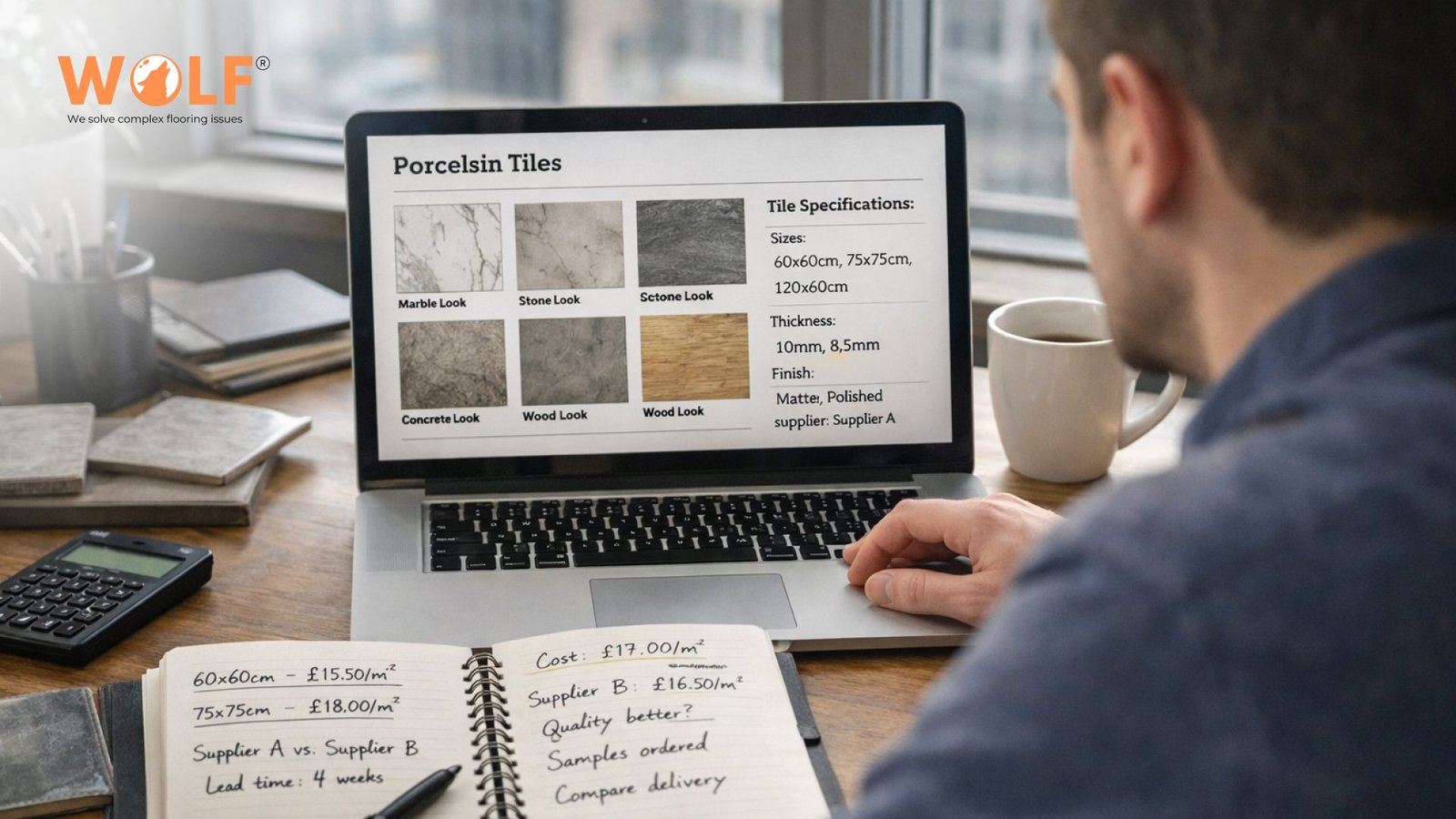
That change in tone reflects a supply market that has matured considerably. Indian tile manufacturing, concentrated in Morbi, Gujarat, now operates at a scale and technical standard that simply did not exist fifteen years ago. Modern production technology influenced by global manufacturing standards, standardized production controls, and export infrastructure built specifically for demanding international markets have transformed what Indian manufacturers can offer and what UK tile importers can expect to receive.
Indian manufacturers operate with lower production costs while using advanced machinery aligned with international production benchmarks. For UK showrooms managing tight margins in a competitive retail environment, that cost structure creates meaningful room to work with, without asking buyers to make product compromises they cannot defend to their customers.
From stone-look finishes to high-gloss surfaces, Indian factories produce a wide range suitable for modern UK interiors, particularly kitchens, bathrooms, and open-plan living spaces. The range depth means a single supplier relationship can cover multiple product lines rather than requiring buyers to manage separate sourcing relationships for each aesthetic category.
Explore collections that match your showroom’s product positioning before finalizing your import plan.
Working with Indian tile manufacturers with export experience is a fundamentally different proposition from working with a production-focused factory that happens to accept international orders. Export-experienced suppliers understand documentation requirements, shipping timelines, and compliance expectations before the conversation starts, not after the order is placed.
UK tile importers increasingly prefer working with quality porcelain tiles from India for import due to consistency and pricing advantage, particularly when managing multi-phase project supply alongside showroom stocking.
Whether you are stocking a single showroom or supplying multiple projects across a trading year, porcelain tile exporters in India to UK markets can handle volume requirements efficiently. Production capacity scales with order growth, which matters for buyers who want to build a supply relationship that does not need to be replaced as their business develops.
The most common mistake UK buyers make when approaching post-Brexit imports is treating compliance as someone else’s problem. It is not. Understanding the framework takes less time than most buyers expect, and it protects against delays and costs that are entirely avoidable.
The core change is straightforward. The UK now operates its own conformity marking system.
UKCA (UK Conformity Assessed) is the UK’s marking system, but CE marking continues to be accepted for many construction products under current transitional arrangements. For tiles, this relates to compliance with construction product standards. The practical implication for importers is that documentation needs to be verified against UK requirements, not just EU ones.
Many experienced Indian exporters have aligned their compliance processes to meet both CE and UKCA expectations. That dual alignment simplifies the import process for UK buyers who also supply projects with cross-border specification requirements.
The documentation burden for UK tile imports is manageable when a supplier is prepared for it. UK importers typically require:
A supplier who treats this list as routine rather than burdensome is telling you something important about their export maturity. Delays at UK customs almost always trace back to incomplete or incorrectly prepared documentation, not to the product itself.
The factory price is where the calculation starts. It is rarely where it ends.
UK tile importers who approach Indian sourcing by comparing factory quotes directly against European invoice prices are comparing the wrong numbers. The relevant figure is landed cost, and building that number accurately determines whether a sourcing decision actually works commercially. For first-time importers, this calculation often determines whether a sourcing decision is viable or not.
Tariffs depend on trade agreements and the commodity classification codes applied to the specific tile formats being imported. Duty rates should be confirmed with a licensed customs agent before finalizing any sourcing decision, as the applicable rate affects margin materially.
Shipping from India to the UK varies depending on container size, routing, seasonal demand cycles, and fuel surcharges. An experienced exporter will be able to provide current freight estimates and flag timing considerations that affect rate stability.
Exchange rate movements between GBP and USD, the currency in which most Indian tile exports are invoiced, introduce a variable that European sourcing does not carry in the same way. Buyers building annual purchasing plans benefit from understanding how their supplier handles pricing in volatile currency periods.
The focus should always be on the complete landed cost, not the factory price. A tile priced lower at origin but carrying higher freight, duty, and compliance costs can produce a worse commercial result than a higher-quoted alternative with cleaner logistics. This is the calculation that separates experienced importers from buyers who get surprised after the container arrives.
Ask your supplier for a detailed cost breakdown before confirming any order.
For most UK showroom buyers and distributors, starting with a 20ft container is the most practical approach.
It allows:
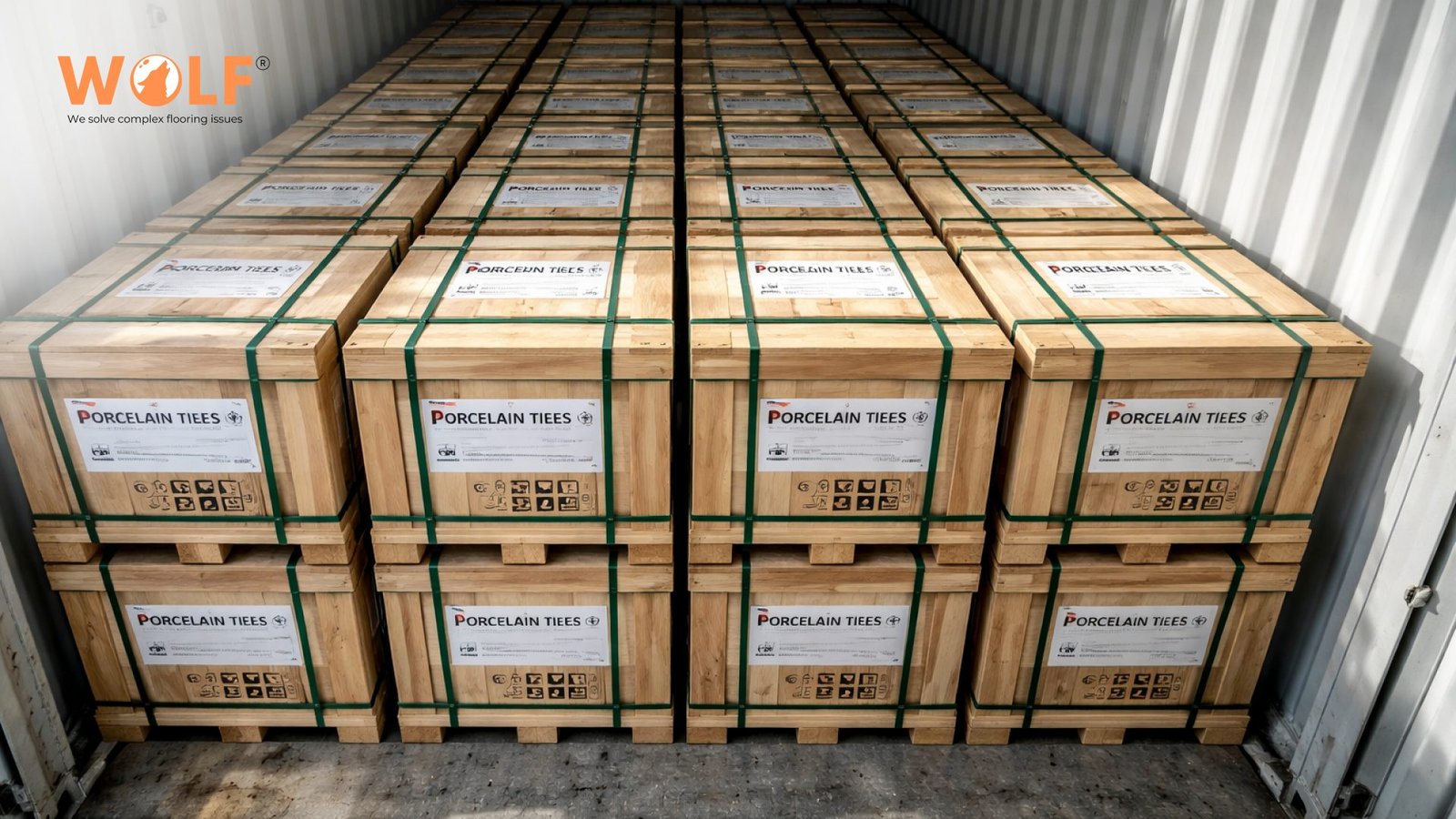
For 600×1200mm tiles, a 20ft container typically provides coverage suitable for showroom stocking and mid-scale project supply, giving buyers a manageable entry point without overcommitting capital before demand is established.
Most experienced UK importers begin with a 20ft container and scale up once product movement is validated in the market.
The UK tile market is competitive enough that for UK tile importers, the difference between a good supplier and the right supplier is measurable in margin, repeat business, and the ability to give clients consistent products across multi-phase projects.
The best porcelain tile manufacturers in India for export are not simply large factories. They are organizations that have built export-specific systems around documentation, communication, batch management, and shipping coordination. That infrastructure is what makes them reliable partners rather than just reliable producers.
For UK market entry, certification is not optional. Importers should verify ISO quality management certification, CE and UKCA compliance documentation, and EN 14411 performance standards before shortlisting any supplier. These certifications are the baseline, not a differentiator.
A supplier who can handle your current order volume but cannot scale with your growth creates a problem at the worst possible moment. Confirm production capacity explicitly, not just for current requirements but for where your purchasing is likely to go.
One good shipment proves that a factory can produce the right product. It does not prove they can do it repeatedly. The question to ask any potential supplier is not what their quality looks like on the first order, it is what their batch traceability and consistency record looks like across the tenth.
Understanding what UK buyers are specifying helps sharpen sourcing decisions before a container is committed.
The dominant residential trend in UK interiors over the past several years has been a move toward natural surfaces, tactile finishes, and spaces that feel considered rather than glossy. Matte stone-look tiles have followed that shift directly, becoming the default specification for kitchens, open-plan living areas, and bathroom floors in mid-to-high-end residential projects.
Explore 600×1200mm porcelain tiles for UK kitchens
These formats are widely stocked in UK showrooms due to their versatility and consistent demand. They offer the balance of size, practicality, installation efficiency, and visual continuity that UK contractors and interior designers have come to expect as standard.
The architectural direction of UK residential design, particularly in new-build and higher-specification renovation, has moved steadily toward larger formats with reduced grout line presence. The visual logic is clean: more tile surface, fewer interruptions, a more seamless result across walls and floors.
Browse 1200×1200mm porcelain slab tiles
These formats are increasingly specified in commercial applications too, particularly in hospitality and retail environments where surface quality is part of the brand experience.
At the upper end of the market, oversized format tiles are establishing themselves as the finish of choice for feature walls, luxury bathroom installations, and architectural cladding applications. The move toward these formats reflects a broader shift in how premium interiors are being designed and sold.
See 800×1600mm premium porcelain collection
For showrooms positioning in the premium segment, having access to these formats from a single export-capable supplier simplifies both the product story and the logistics.
A well-run export process is invisible when it works. When it does not, the implication is felt at UK customs, not at the factory.
The typical export sequence for UK shipments runs as follows:
The stage that separates reliable exporters from everyone else is step 7. Complete, correctly prepared shipping documentation that anticipates UK customs requirements rather than responding to queries after the container has arrived is a mark of genuine export maturity.
An experienced exporter ensures zero documentation errors, which can otherwise delay clearance at UK ports.
You can explore our export documentation and logistics process to understand how each stage is managed before and after production.
The logistics picture for Indian exports to the UK has improved significantly over the past several years. Route reliability, port handling at major Indian export facilities, and transit time consistency have all developed in ways that benefit UK buyers directly.
Shipping from India to the UK generally takes 3 to 5 weeks, depending on port routing and vessel schedules. UK buyers building project timelines should add production time and port handling when calculating total lead time from order confirmation to delivery.
Containers are typically shipped from Mundra Port, Gujarat (India) to major UK ports such as Felixstowe, Southampton, or London Gateway. These are high-volume, well-managed entry points with established customs handling processes for tile imports, which reduces the risk of clearance delays for well-documented shipments.
All shipping and compliance documents are prepared before dispatch, ensuring that customs clearance in the UK proceeds without preventable delays. For buyers managing project-specific delivery windows, that preparation is what makes the difference between a shipment that arrives on schedule and one that does not.
UK buyers often evaluate imported tiles based on performance, not just appearance. That is the right instinct, and the specifications that govern Indian porcelain tile production reflect standards that international markets have come to rely on.

Here is what the key performance figures mean in practical terms:
In practical terms, this means the tiles are built for long-term performance across real-world environments, not just visual appeal. This is why Indian porcelain tiles are trusted across global markets, from residential homes to high-traffic commercial spaces.
Post-Brexit sourcing requires more than a competitive price list. It requires a supplier who understands what UK importers are accountable for and can support that accountability with documentation, not just assurances.

Wolf Porcelain Tiles focuses on:
For UK showroom buyers building reliable supply chains in a changed regulatory environment, that combination of manufacturing quality and export execution is what makes a supplier relationship commercially durable.
UKCA marking confirms that products meet UK standards for construction materials sold in Great Britain. Importers must ensure that compliance documentation from their supplier aligns with UK requirements, which replaced CE marking for the GB market following Brexit.
India offers competitive pricing, a wide product range suited to current UK design trends, and export-experienced manufacturers capable of meeting UK compliance and documentation requirements. For showroom buyers managing margin pressure in a competitive retail environment, that combination is commercially meaningful.
If your current supplier is struggling with documentation accuracy, pricing predictability, or supply consistency, those are operational signals worth taking seriously. Post-Brexit compliance requirements have raised the bar for what reliable supply actually looks like in practice.
Primarily in Morbi, Gujarat, one of the world's largest and most technically advanced tile manufacturing regions. Morbi's production cluster combines scale, variety, and internationally aligned manufacturing technology in a way that gives buyers genuine options within a single sourcing geography.
Experienced exporters prepare and provide all required documentation as a standard part of the export process. Buyers should confirm this explicitly during supplier evaluation rather than assuming it.
600×1200mm and 1200×1200mm are the formats with the strongest current demand across UK residential and commercial applications. The 800×1600mm format is gaining traction in the premium segment. A well-stocked showroom benefits from having access to all three.
Total landed cost includes product price, freight, import duties, and currency exposure. The factory quote is the starting point, not the final number. Buyers who calculate landed cost accurately before committing to a supplier avoid the margin surprises that come from comparing only unit prices.
Typically 3 to 5 weeks from Mundra Port, Gujarat to major UK ports including Felixstowe, Southampton, and London Gateway, depending on routing and vessel schedules. Total lead time from order confirmation, including production and port handling, should be factored when planning project delivery windows.
Yes. Most UK buyers begin with a 20ft container, which provides a practical entry point for showroom stocking and demand validation without overcommitting capital. Scaling to larger volumes once product movement is established is the most common progression for successful UK import relationships.
If you are sourcing porcelain tiles for UK trade, retail, or distribution, the supplier relationship you build now will shape your product range, your compliance position, and your margin structure for years ahead. In a post-Brexit market where the sourcing landscape has genuinely changed, getting that relationship right is worth the evaluation time.
Request UK-compliant documentation and samples
Get expert support on product selection, compliance, and export logistics, tailored for the UK market