

Close
Choosing porcelain tiles for bathrooms in the Netherlands is about more than aesthetics. Dutch bathrooms are compact, heavily used, and expected to last. The tile you choose determines how your bathroom performs for the next decade: moisture resistance, ease of cleaning, and long-term durability.
Porcelain sits at the centre of that decision.
This guide covers why porcelain outperforms ceramic in wet environments, which sizes and finishes suit Dutch bathrooms in 2026, how design trends are shaping material choices, and why tile exporters in India to the Netherlands have become a serious and credible sourcing option for trade buyers.
Let’s start with what actually matters in a bathroom: performance under daily moisture, ease of maintenance, and long-term durability. Porcelain earns its place on all three counts, not through marketing language, but through material properties that are straightforward to verify.
Porcelain is fired at temperatures above 1200°C and under greater pressure than standard ceramic. This makes the tile significantly denser and more durable in everyday use. The key number to know is water absorption. Porcelain tiles sit below 0.5%, which is the threshold that classifies a tile as fully vitrified.
As a trusted porcelain tile manufacturer from India, we can confirm what that means in real-world use:
All Wolf porcelain tiles are verified under EN 14411 standards, the European benchmark for ceramic and porcelain tile performance. At first glance, ceramic might look like the cheaper option. In real-world use, that difference usually disappears within a few years once maintenance, repairs, and eventual replacement are factored in. Porcelain also handles structural load reliably. Vanity units, freestanding baths, and daily foot traffic do not stress the tile body when the correct thickness and format are specified.
In simple terms: Porcelain handles moisture better, lasts longer, and needs less maintenance than ceramic. For a bathroom used every single day, that gap compounds significantly over time.
In 2026, Dutch bathrooms favour earthy palettes: soft beiges, taupes, muted greens, and sandy neutrals. Stone-inspired tiles referencing limestone and travertine dominate, with tactile matte finishes that suit both modern and classic interiors.
Modern bathroom tiles from Indian manufacturers closely match this direction. Digital printing technology allows Indian factories to replicate travertine veining, aged wood grain, and raw concrete texture with precision that rivals European production. The visual result is warm and natural. The performance stays porcelain.
Tile format has a direct effect on how a bathroom reads visually. In Dutch homes where space is often limited, size selection becomes one of the more practical decisions in the whole project.
600×1200mm porcelain tiles for bathroom walls and floors offer clear advantages in compact Dutch bathrooms:
600×600mm porcelain tiles for shower floors offer a different but equally valid set of benefits:
Using large tiles on walls alongside a smaller floor format adds visual layering without introducing competing colours or patterns. It defines each surface clearly while keeping the palette cohesive, a technique that works particularly well in bathrooms with limited natural light.
For shower floors specifically, surface texture and slip resistance matter more than size. A smaller tile with a matte or structured surface gives better grip underfoot and is considerably safer in a wet area than a large smooth tile. Most homeowners only realise the importance of slip resistance after installation, and by then, reversing the decision is costly.
Waterproof porcelain tiles for bathrooms are defined by measurable properties that any reputable supplier will provide in a technical data sheet. You can review our manufacturing quality and certifications to verify these standards directly.
What makes porcelain tiles waterproof?
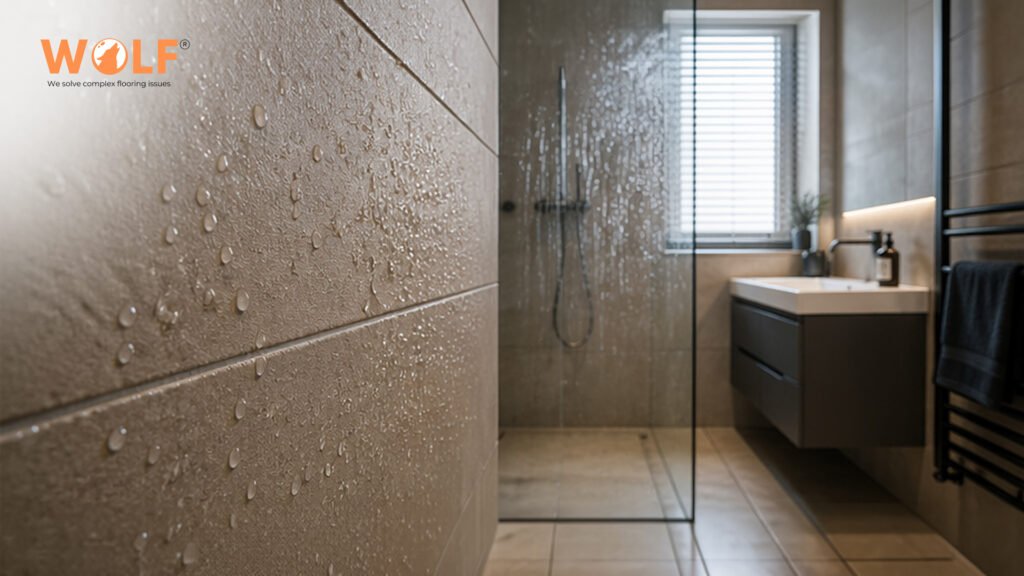
Key Fact: Porcelain absorbs less than 0.5% water. That single figure is the most important specification to check.
In short: if a tile cannot show you these numbers in writing, that is a reason to pause before ordering.
This is one of the most common decision points in bathroom design. Here is a clear way to think about it.
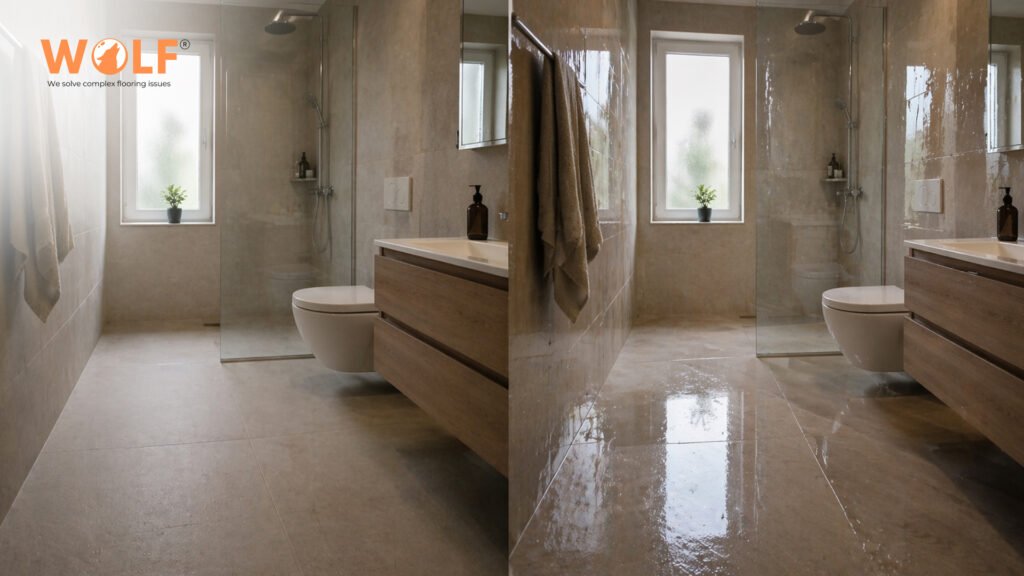
Leading matte finish porcelain tile exporters India now produce EU-compliant collections tailored specifically for Dutch and European bathroom projects. The surface textures and colour palettes closely match where Dutch interior design is heading.
The practical approach: use matte tiles on all floor surfaces and inside the shower. Use glossy tiles on dry wall surfaces where brightness is needed.
A decade ago, sourcing tiles from India would have raised legitimate questions about quality consistency and logistics. That has changed considerably over the past decade.
The Indian tile industry, centred in Morbi, Gujarat, has developed into a technically advanced manufacturing sector. Established factories use the same high-pressure kilns and digital surface printing technology as European manufacturers. Their tiles are verified under EN 14411 standards, the benchmark European buyers and contractors rely on for ceramic and porcelain tile quality.
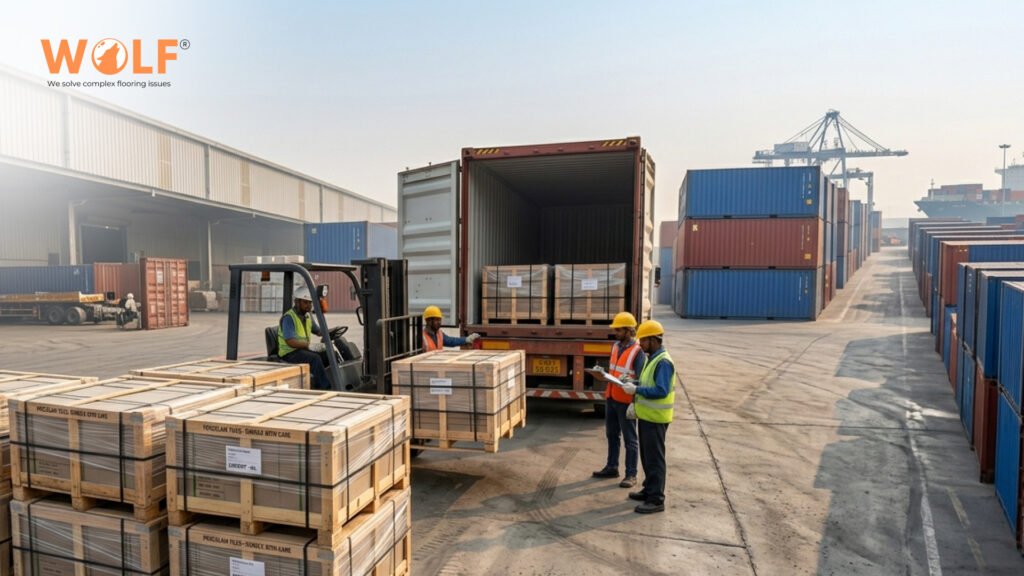
Here is what makes Indian-sourced tiles a credible choice today:
The pricing reality: Indian porcelain tiles typically reach Dutch buyers at a cost noticeably lower than equivalent European-manufactured products. This is a function of lower production costs, not lower standards.
Shipping to the Netherlands is handled through regular freight routes into Rotterdam. Packaging is designed for long-haul transit, documentation meets Dutch customs and EU import requirements, and pre-shipment samples are available before any bulk order is confirmed.
Learn more about how we export to European markets and the formats currently available for Netherlands delivery.
If you are a Dutch retailer, explore private label tile options for Dutch retailers to build your own branded range sourced directly from India.
Before committing to any tile, work through these points. It takes twenty minutes and can save a costly mistake after installation.
Bathroom Dimensions: Measure accurately, add 10% for cuts and breakage.
Format Selection: Large-format for compact bathrooms; more flexibility in larger spaces.
Slip Rating: R10 minimum for floors, R11 for shower bases. Confirm on the technical data sheet.
Water Absorption: Below 0.5% for any bathroom tile.
Finish and Use Zone: Matte for floors and shower areas. Glossy for dry wall surfaces only.
Batch and Shade Consistency: Confirm shade code and calibre match across all deliveries.
Supplier Documentation: For tiles imported from outside the EU, confirm CE marking and EN 14411 compliance accompany the order.
For a deeper look at EU tile standards, the European Tile Standard EN 14411 is a useful reference when reviewing supplier specifications.
Large-format matte tiles in an earthy or stone-inspired finish, with water absorption below 0.5% and a minimum R10 slip rating.
Families, households with elderly users, and anyone prioritising long-term durability. Contractors also prefer porcelain where post-installation issues need to be avoided.
Porcelain absorbs less than 0.5% water versus 3% or more for ceramic, making it non-porous, mould-resistant, and structurally stable in wet conditions.
Italy and Spain are established European sources. Indian manufacturers in Gujarat are increasingly competitive on quality and price, with EN 14411-verified tiles and direct freight routes into the Netherlands.
A matte or structured-surface tile with a minimum R10 slip rating. Glossy tiles become hazardous when wet and are not suitable for floors.
Mild detergent and warm water. No sealing required. Clean grout lines in shower areas periodically to prevent discolouration.
Ready to source porcelain tiles for your Dutch bathrooms. Here is what we offer:
Request bathroom tile samples in matte and glossy to see the quality for yourself before committing to a full order.
Choosing porcelain tiles for bathrooms in the Netherlands is a practical decision as much as a design one. Porcelain delivers where bathrooms demand it most: water resistance, durability, slip safety, and low long-term maintenance. Combined with the design direction Dutch interiors are moving in during 2026 and the genuine quality now available from Indian manufacturers at accessible price points, porcelain makes a strong case at almost every budget level.
Start with your bathroom dimensions, confirm your slip and water absorption requirements, and let finish and format follow from there. Request bathroom tile samples in matte and glossy before committing to a full order.