

Close
Walk into a well-executed commercial interior and the flooring either earns its place or exposes a decision made under budget pressure. In offices, hotels, and retail environments, tiles carry more daily punishment than almost any other surface and when the specification goes wrong at scale, the fallout isn’t just financial. It’s a delayed handover, a client escalation, and a remediation cost that was never in the budget.
That’s why porcelain tiles for UK commercial projects have become the default specification across the fit-out sector. They deliver the durability commercial interiors demand, the large-format aesthetic designers want, and when sourced from the right manufacturer, a procurement cost that makes large-volume projects viable without compromising quality.
This guide is for fit-out contractors, retail designers, hospitality project managers, and office specifiers who need to make the right call, not just the right-looking one.
Most specification problems in commercial tile projects don’t originate from the tile itself. They originate from the supply chain behind it.
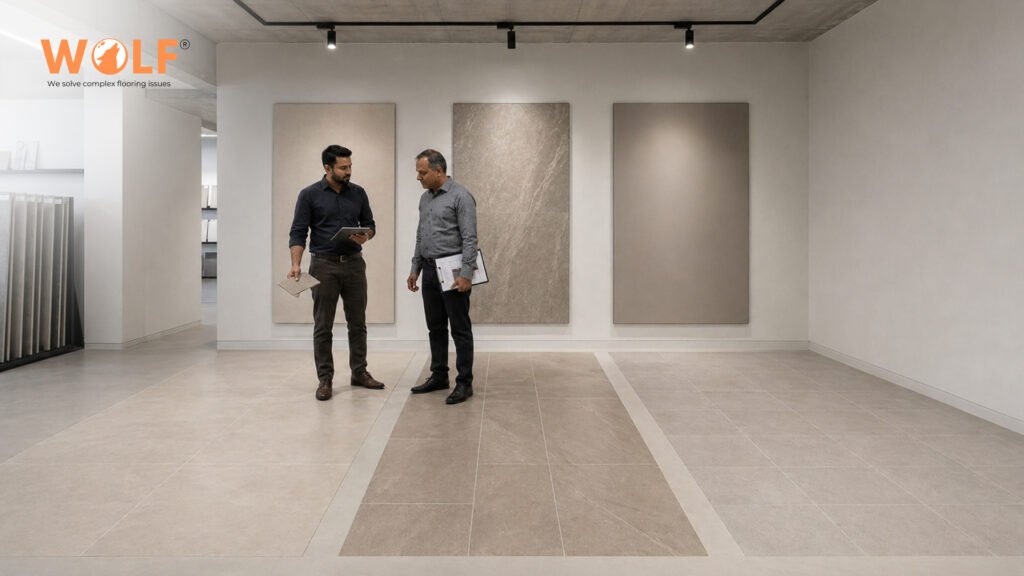
A mismatched batch across a phased office refurbishment becomes a visible defect. Colour drift across a hotel rollout is a brand problem. A retail surface that dulls under daily cleaning within a year is a fit-out failure, regardless of unit price. These aren’t edge cases, they’re the most common failure modes in large-format commercial tile procurement, and they almost always trace back to a supplier without the production infrastructure to sustain consistency at volume.
Working with a porcelain tile manufacturer with 5 state-of-the-art production lines matters beyond capacity. It means batch calibration, controlled kiln output, and the logistics structure to support phased UK delivery, without the buyer absorbing stock risk between phases.
A tile that looks right in a sample box can still be wrong for the job. In commercial specification, the question isn’t only whether a tile performs, it’s whether the specification can be defended at tender, on site, and at a three-year review.
PEI Rating: Class 4 covers heavy commercial traffic. Offices, retail floors, hotel corridors. Class 5 applies in higher-intensity zones: concourses, transport-linked retail, large public-facing entries. PEI is one of the first questions any reputable commercial porcelain tile supplier should answer with documentation, not verbally.
Slip Resistance: R10 is the practical baseline for general commercial circulation. R11 applies where moisture exposure is a factor, hospitality service corridors, commercial washrooms, and food-retail adjacencies.
Water Absorption: Porcelain-grade performance sits at ≤0.5%, the threshold that separates genuine porcelain from ceramic products that won’t survive commercial cleaning regimes.
All tiles supplied for UK commercial projects are verified under EN 14411, the European standard for ceramic and porcelain tile classification, covering dimensional tolerances, surface quality, water absorption, and mechanical performance. This is the benchmark UK building control, main contractors, and client procurement teams recognise and require.
Breaking Strength and Modulus of Rupture: Particularly relevant for large-format tiles, where point loads from trolleys or display fixtures stress unsupported tile spans.
Reaction-to-Fire Classification: A non-negotiable requirement for occupied commercial buildings under UK Building Regulations.
Dimensional and Shade Tolerance Across Batches: The specification point most likely to cause problems in phased delivery. Document it and confirm it in writing, don’t assume.
Our certifications including ISO 9001, CE Marking and EN 14411 compliance are the documentation that lets a specification survive scrutiny from a building control officer, a main contractor, and a client review simultaneously.
Tile format isn’t a purely aesthetic call. It determines grout frequency, cleaning burden, installation sequencing, and how a space reads under artificial light. all of which carry real weight in commercial fit-out planning.
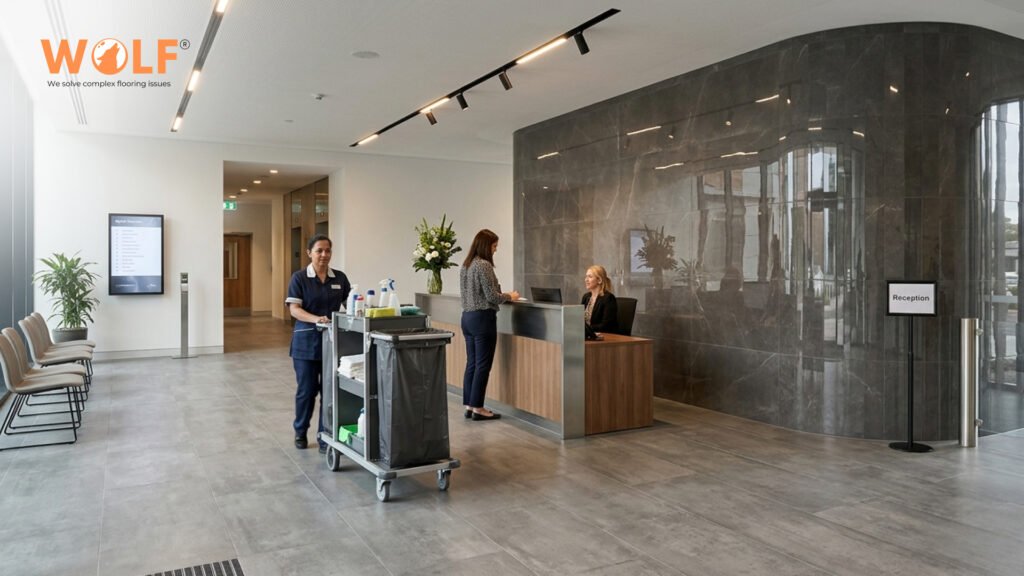
Hotel Lobbies and Office Receptions – 1200×1200mm (48×48)
In high-visibility entry zones, large format reduces grout frequency and creates a surface that reads as considered rather than assembled. 1200×1200mm porcelain tiles for commercial lobbies balance visual scale with installation practicality in ways smaller formats cannot. In premium office entrances and hotel receptions, that first-impression logic is precisely the brief.
Office Corridors and Hotel Guest Floors – 600×1200mm (24×48)
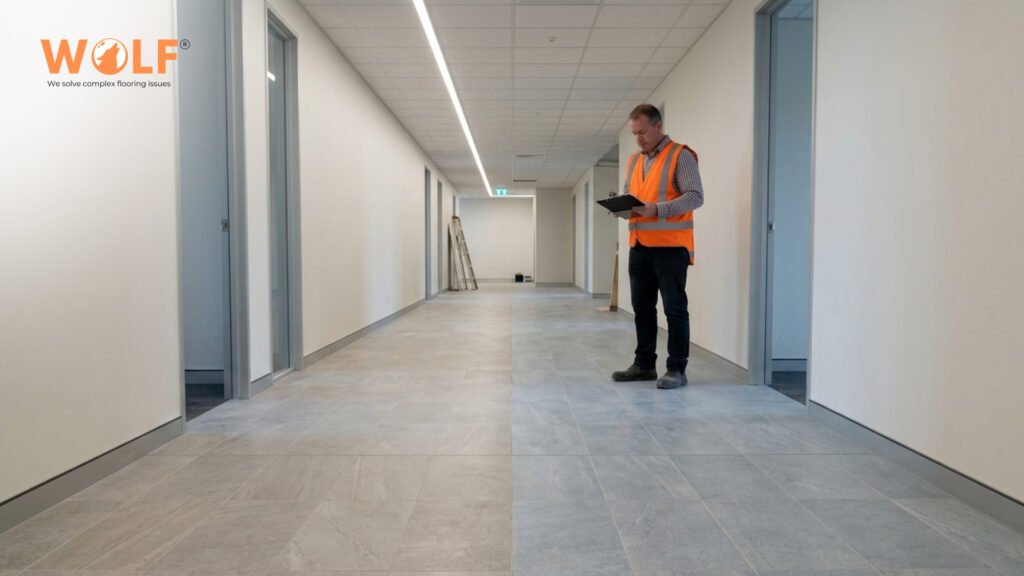
Corridors are directional spaces. A 600×1200mm tile laid lengthways extends the sightline, makes the corridor read wider, and reduces jointing complexity compared to staggered smaller formats. 600×1200mm porcelain tiles for commercial corridors are also one of the most globally recognised commercial specifications, which simplifies procurement, installation briefing, and replacement sourcing across long projects.
Commercial Washrooms – 600×600mm (24×24)
Drainage falls, cuts around sanitaryware, and maintenance access requirements make compact zones the wrong place to push large format for its own sake. A 600×600mm module gives better control over drainage grading and the flexibility to handle the varied cuts commercial washrooms consistently demand.
Flagship Retail and Feature Walls – 800×1600mm Premium Slabs
For brand-driven environments, premium showrooms, hospitality statement walls, flagship retail entries. 800×1600mm premium porcelain slabs remove joint interruption almost entirely. The surface reads as continuous, which is exactly what high-end retail and luxury hospitality specifications are reaching for.
Finish decisions in commercial specification should be driven by zone function, cleaning regime, and maintenance expectations, not by what looks best in a presentation deck.
Matte porcelain is the lower-risk choice across most commercial zones. It conceals footfall marking between cleaning cycles, holds up under mixed artificial lighting, and presents fewer slip concerns where wet mopping or chemical agents are routine. It’s also the Finish facility management teams find easiest to handover without a lengthy maintenance protocol attached.
High-gloss porcelain earns its place in controlled, lower-traffic zones where visual impact is brief. Hotel reception surrounds, luxury retail entries, and concierge feature walls. Reflectivity adds perceived height and quality in these spaces.
The discipline is placement: high-gloss in general circulation areas, or anywhere wet cleaning is daily, is likely to create maintenance and appearance issues over time. Used deliberately in the right zone with an agreed cleaning protocol, it’s a legitimate and effective choice.
The working principle: Matte where footfall is high, and maintenance is routine. High-glossy where impact is the priority, and the surface can be properly managed.
The question UK commercial buyers have moved past is whether Indian tile manufacturers can supply the UK market. The current question is how to evaluate them rigorously, because the difference between a consistent exporter and an unreliable one rarely shows up in a sample box.
What separates capable large format porcelain tile exporters in India for UK commercial projects isn’t tile quality alone. It’s production consistency across large runs, documentation that holds up in UK commercial procurement, and logistics planning that fits phased delivery schedules without requiring buyers to front-load stock between project phases.
There’s also a subtler procurement risk that often goes undiscussed: shade variation discovered mid-project. When a second delivery doesn’t match the first, not dramatically, but enough to be noticeable under site lighting, the remediation is expensive and rarely visible in the original risk register. This is the failure mode that phased office refurbishments and hotel rollouts are most exposed to, and it’s where manufacturer infrastructure matters most. Facilities without dedicated batch calibration cannot guarantee consistency across repeat deliveries the way purpose-built export operations can.
For UK commercial buyers, the practical checklist before committing to volume:
A supplier who can’t produce these documents upfront is not a viable commercial specification, regardless of price.
If you’re at the specification stage, comparing tile exporters in India for commercial projects, pressure-testing a current supplier on batch consistency, or building a format and finish schedule for a UK office, retail, or hospitality scheme, start with the technical file, not the catalogue.
Request commercial project pricing and specifications to get format-specific data sheets, CE certification, batch records from comparable orders, and indicative pricing based on your scope and delivery phasing, the material your specification team needs before the brief locks, not after
1200×1200mm (48×48) is the most commonly specified format for high-visibility entry zones. It reduces grout frequency across wide floor planes and produces a cleaner finish where first impressions carry the most weight.
Request production records from comparable past orders, physical samples from different batches, and written confirmation of how shade and dimensional tolerance is managed across repeat deliveries. This is especially important for phased projects where tile arrives across multiple shipments.
In controlled, lower-traffic zones where visual impact is the brief, reception surrounds, feature walls, luxury retail entries and where a cleaning and maintenance protocol can be established before handover, not after.
PEI Class 4 for heavy commercial circulation. Class 5 for higher-intensity zones such as hotel concourses or large public-facing entries.
R10 as the general commercial baseline. R11 for higher moisture-exposure areas including service corridors, washrooms, and food-adjacent retail zones.
Technical data sheets, CE certification, EN 14411 compliance documentation, batch consistency records, fire classification, dimensional tolerance data, and full export compliance paperwork. These should be provided upfront, not requested as an afterthought.
Lead times should account for production scheduling, documentation, shipping, customs clearance, and project phasing, confirmed in writing at quotation stage based on format, quantity, and delivery structure. Never assume a standard timeline; get it in writing.