

Close
German construction projects leave no room for material failures. A commercial renovation in Frankfurt or residential development in Munich requires quality documentation from day one. Not as paperwork, as proof.
This is why German project managers, procurement officers, and QC teams increasingly source porcelain tiles from ISO certified tile exporters in India. The German Porcelain tiles market continues growing steadily, with Italy holding a significant import share. Yet Indian manufacturers with EN 14411 compliance and CE marking are proving themselves as reliable alternatives for bulk orders.
The difference between a smooth project and a costly delay? Understanding what ISO certification actually means and knowing how to verify it. Wolf Porcelain Tiles, a leading manufacturer with two decades of experience, exemplifies this commitment to quality systems. To learn more about Wolf Porcelain Tiles and our certifications and legacy, visit our comprehensive company profile.
Germany imports significant volumes of Porcelain tiles annually. Even with duties on Indian tiles, imports continue. The reason? Quality-certified Indian manufacturers meet German technical standards while offering cost advantages over European suppliers.
Porcelain tiles dominate a substantial portion of Germany’s tile market. German buyers prefer them for practical reasons: they handle freezing winters without cracking, resist water penetration, and survive heavy foot traffic in commercial buildings.
Every serious project specification asks for the same things:
Market access compliance: Your tiles must meet European standards to enter Germany legally
Quality system proof: Documentation showing consistent manufacturing processes throughout production
Laboratory verification: Independent test results from accredited testing facilities
Batch consistency: Guarantee that tiles ordered in spring match tiles delivered in autumn
Porcelain tile exporters in India to Germany have built their facilities and systems specifically to meet these requirements. They invested in the certifications, testing equipment, and quality controls that German projects expect.
Morbi, Gujarat produces the majority of India’s Porcelain tiles. Walk into a leading facility and you’ll find industrial manufacturing powered by European equipment and verified processes.
ISO certified tile exporters in India invested heavily in technology over the past decade. Modern Morbi facilities run continuous production lines with equipment sourced from Italy and Germany. The same kiln manufacturers supplying European factories also supply Morbi plants.
Production infrastructure includes:
Advanced firing systems maintain precise temperature control for consistent tile quality throughout bulk orders. This precision matters when German projects require large volumes delivered across multiple shipments.
High-pressure forming creates dense tile bodies that resist moisture and meet porcelain classification requirements. The result? Tiles that survive German winters without frost damage.
Digital surface technology producing photorealistic designs matching architectural specifications. Whether you need marble effects for a Munich office lobby or wood-look tiles for Hamburg residential units, Morbi tile manufacturers with quality certification can produce it.
Automated quality screening removing defective pieces before packaging. German buyers receive only tiles passing multiple inspection checkpoints.
Visit a certified facility and you’ll understand why reliable tile exporters in India can commit to large-scale German projects. The manufacturing scale, quality systems, and testing capabilities exist to serve commercial projects requiring delivery consistency over extended construction timelines.
These aren’t promises on paper. They’re observable production systems verified through ISO certification audits and third-party testing.
ISO certification isn’t one piece of paper. It’s several certifications, each proving something specific about how a manufacturer operates. Here’s what matters for German buyers.
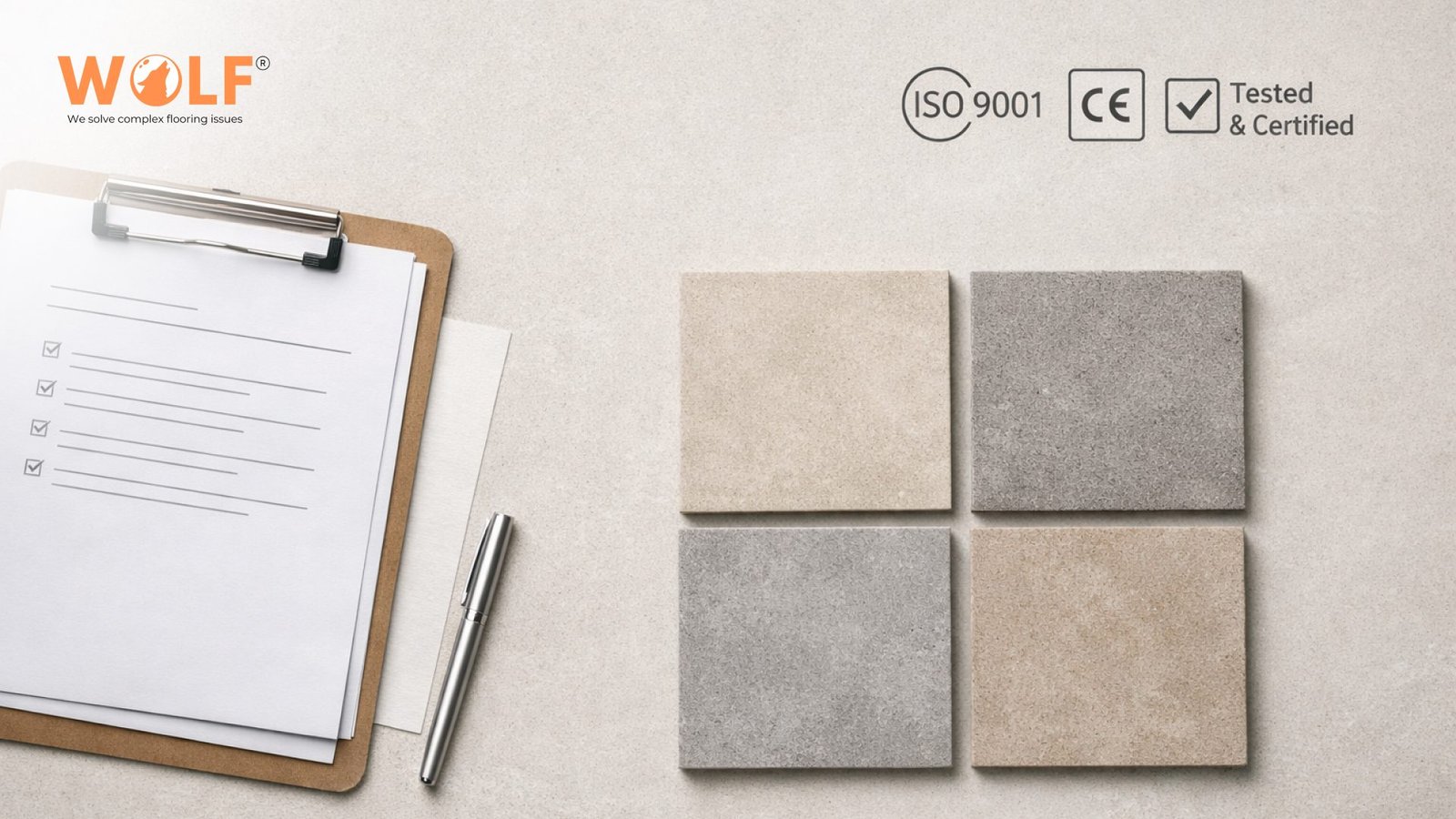
This proves a manufacturer follows identical quality steps for every production batch. Not just sometimes. Always.
What this means: when you order tiles in March and reorder in September, ISO 9001 documented processes give you the highest possible chance of receiving consistent color, size, and quality . The same production parameters, the same raw material specifications, the same quality checkpoints, applied every time.
Without ISO 9001, you’re hoping the manufacturer remembers how they made your first batch. With it, their documented processes guarantee consistency across bulk orders.
German projects increasingly require environmental documentation. How much energy did manufacturing use? How does the factory manage waste?
ISO 14001-certified manufacturers already track this. When you need sustainability data for your project report, they hand it to you. Simple.
This certification focuses on worker safety. Factories serious about worker safety usually run disciplined, well-organized operations. These same habits lead to better quality control and consistent products.
This is different from ISO. It’s about the product itself, not management systems. Every porcelain tile sold in Germany must meet this European standard.
The standard defines what makes tiles acceptable for European markets and sorts them by manufacturing method, water absorption, and intended use. For porcelain tiles, classification as “Group BIa” matters. It means tiles absorb minimal water, which is why porcelain survives German winters without frost damage.
EN 14411 requires testing for durability (breaking strength, scratch resistance), weather resistance (frost, temperature changes), and safety (slip resistance, chemical resistance).
Manufacturers conduct these tests at independent laboratories. Test results ship with your tiles so German buyers can verify them.
Porcelain tiles need CE marking to enter the EU. With no exceptions since July 2013, CE marking for porcelain tiles is mandatory in the EU, under the Construction Products Regulation (CPR).
What CE marking confirms:
When tiles ship from India to Germany, CE documentation comes with every container. Check that paperwork matches your order specifications. As tile exporters in India for global markets, Wolf Porcelain Tiles provides complete CE documentation with every shipment, ensuring smooth customs clearance and project compliance.
Certificates exist. Are they legitimate? Here’s your quick checklist:
Check dates: ISO certificates expire after three years. Request current documentation.
Verify the issuer: Certificates come from accredited organizations. Look up the certification body to confirm legitimacy.
Confirm factory coverage: Certificates should list specific factory addresses, not vague “all facilities” claims.
Request test reports: Ask for actual laboratory test reports, not just claims of compliance.
Look for consistency: Batch codes, certificate numbers, and report references should align logically.
Contact the certification body: For important projects, verify the manufacturer’s certification directly with the issuing organization.
Reliable tile exporters in India expect German buyers to verify documentation. They welcome inquiries about their certifications.
Certification proves capability. Consistency proves reliability.
German projects often span extended timelines. You might order tiles in one phase and need matching tiles months later. Shade variation between batches creates visible problems on installed floors.
ISO-certified manufacturers implement color management systems using specialized equipment to measure color accurately. This technical control prevents shade variation problems.
Statistical process controls track thickness, flatness, and dimensional accuracy. Manufacturers maintain tight tolerances ensuring tiles fit together properly during installation.
Batch documentation with traceability codes links every pallet to production date, manufacturing conditions, and quality test results. If issues arise, root causes are identifiable.
Consider these verification approaches:
Pre-production samples: Order samples from proposed production batch. Test independently at German laboratories if your budget allows.
Witness testing: Send QC representatives to the manufacturer during production. Reputable exporters accommodate this request.
Random lot inspection: Third-party inspection services in India can inspect goods before shipping.
First article inspection: Thoroughly test initial shipment. Use results as a baseline for subsequent deliveries.
Our quality assurance and export team has extensive experience working with German project managers on verification protocols. We understand German procurement requirements and welcome thorough quality checks.
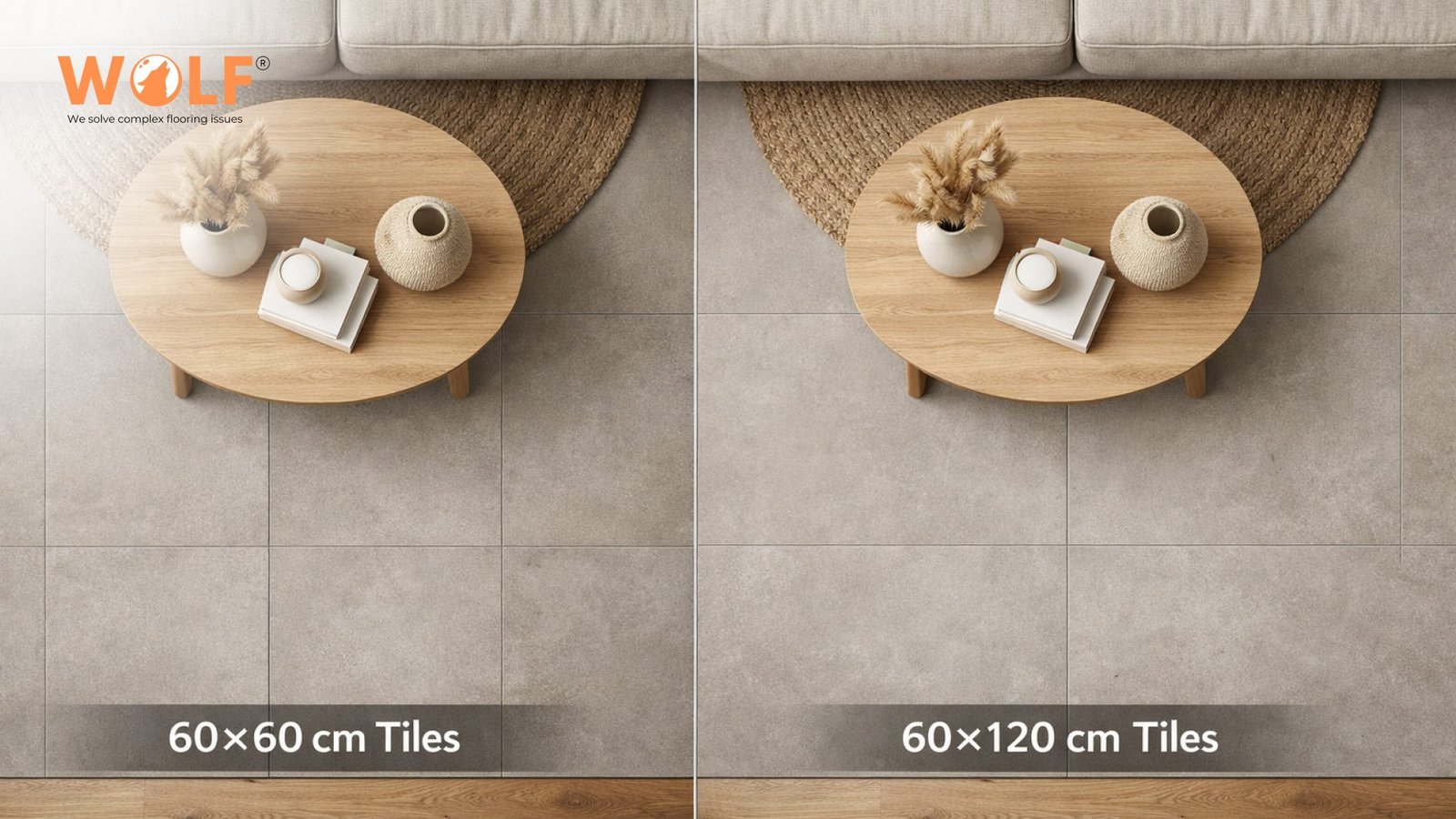
Understanding which tile formats and finishes German projects specify helps evaluate manufacturer capabilities.
The 60×60cm format remains one of Germany’s most specified sizes for residential applications. This format accounts for significant volume in renovation projects, which represent a substantial portion of Germany’s tile market.
This format works well in German residential bathrooms, kitchens, and smaller commercial spaces. Our 24×24 porcelain tiles (600×600mm) collection features multiple designs in this size because demand stays consistent across German residential projects.
Large-format tiles gained traction in German commercial projects. The 60×120cm format suits office lobbies, retail spaces, and healthcare facilities where fewer grout lines mean easier maintenance and more hygienic surfaces.
This size requires precise manufacturing. Any warpage or dimensional inconsistency shows dramatically during installation. ISO-certified manufacturers maintain flatness within tight tolerances essential for professional results. Quality manufacturers offering 24×48 porcelain tile collections feature rectified edges enabling narrow grout joints that German specifications often require.
Most German tile specifications call for matte finishes. Reasons include:
ISO-certified manufacturers offer multiple matte texture options, from ultra-smooth to subtly textured surfaces meeting different slip resistance requirements.
Glossy finishes suit specific applications: feature walls, boutique retail, residential accent areas. German specifications for glossy tiles typically include scratch resistance requirements, cleanability standards, and light reflection specifications.
Manufacturers capable of producing both matte and glossy finishes within the same design family provide specification flexibility German projects value.
German buyers selecting ISO-certified Indian manufacturers balance three factors: quality, cost, and reliability.
Indian porcelain tiles offer cost advantages compared to European alternatives for equivalent quality grades. This difference stems from labor costs and production scale, not compromised standards.
For substantial commercial projects, these savings matter while maintaining EN 14411 compliance and CE marking. Total costs include product pricing, shipping to German ports, import duties, quality verification, and lead times (typically two to three months from order to German warehouse).
Smart procurement officers run complete cost analyses. Indian tiles remain cost-effective after duties and shipping when quality certification is verified.
For over two decades, Wolf Porcelain Tiles has manufactured Porcelain tiles using Italian technology with comprehensive quality systems. As ISO-certified manufacturers, we understand what German project managers require.
Our certifications include:
We maintain batch-to-batch consistency through documented processes. Every production run undergoes testing per international standards. Technical data sheets accompany all shipments with laboratory-verified results.
German buyers appreciate our approach to documentation. When you request compliance packages, you receive complete technical files including certificates, test reports, declarations, and batch traceability data.
If you’re evaluating Indian tile manufacturers for German projects, follow this process:
Qualification Phase: Request ISO certificates and verify validity. Obtain EN 14411 test reports from accredited labs. Review CE marking documentation. Check references from other European clients.
Sample Evaluation: Order production samples, not just showroom pieces. Test independently if budget allows. Assess packaging adequacy for shipping. Evaluate documentation quality.
Small Order Trial: Place initial order for one project phase. Monitor delivery timeline and packaging condition. Conduct thorough quality inspection upon receipt. Track installation feedback from contractors.
Relationship Building: Visit factory if feasible. Establish clear quality specifications. Define batch acceptance criteria. Create escalation procedures for issues.
Ongoing Verification: Random batch testing during larger projects. Periodic certificate renewal checks. Regular communication on specifications. Document any quality variations.
Germany’s tile market continues to grow steadily. Renovation projects dominate the market, and these projects increasingly source from certified international suppliers offering quality at competitive prices.
For German project managers, this creates an opportunity: access to ISO-certified, EN 14411-compliant tiles from manufacturers invested in meeting European standards.
The manufacturers with quality certifications, documented processes, and genuine capability are precisely the reliable partners German projects need.
Verify ISO 9001 for quality management, ISO 14001 for environmental systems, and check certificate validity dates. Confirm certificates come from accredited certification bodies and cover the specific factory producing your tiles.
EN 14411 is a product standard specifying tile characteristics and test methods, while ISO 9001 is a quality management system standard. EN 14411 proves the product meets European technical requirements, ISO 9001 proves the manufacturer has documented quality processes.
CE marking is mandatory for Porcelain tiles sold in the EU. It indicates tiles conform to EN 14411 and meet Construction Products Regulation requirements. Without CE marking, tiles cannot legally enter the German market.
Confirm the laboratory holds international accreditation, verify test methods match European standards, check sample identification matches your order specifications, and contact the laboratory directly for critical verifications.
Every shipment should include a commercial invoice, packing list, CE Declaration of Performance, EN 14411 test reports, batch identification numbers, and origin certificates for customs clearance.
ISO-certified manufacturers use color measurement equipment for control, statistical process control for dimensional accuracy, and complete batch traceability linking every pallet to production parameters and quality test results.
60×60cm format dominates residential applications, while 60×120cm suits commercial projects. Most specifications call for matte finishes due to slip resistance requirements and contemporary aesthetics.
Wolf Porcelain Tiles provides German project managers, procurement officers, and QC teams with complete technical documentation meeting your verification requirements.
Our compliance package includes:
For German construction projects requiring documented proof of quality systems, consistent manufacturing processes, and European standard compliance, Wolf Porcelain Tiles delivers the certification depth German procurement demands.
We manufacture large-format porcelain in the specifications German projects require: 60×60cm and 60×120cm formats in both matte and glossy finishes, with frost resistance, low water absorption, and durability meeting EN 14411 requirements.
Download Wolf’s certification and compliance package and give your QC team the documentation they need to approve sourcing with confidence. To discuss project-specific requirements, contact our export team directly.