
Close
There is a moment every growing US tile brand reaches.
Sales are strong. Demand is steady. But margins stop improving.
The supply chain is working against the brand rather than for it. Every reorder goes through a middleman. Every competitor has access to the same catalog. Every price comparison a customer runs online erodes the premium the brand has worked to build.
This is why many are turning to OEM porcelain tile manufacturers in India for export to take control of pricing, branding, and supply.
Here is where most brands get it wrong: they look for a better distributor instead of building a better product. Many brands breaking out of that ceiling in 2026 are not finding better distributors. They are building their own products, designing their own collections, putting their own name on the box, and controlling the commercial equation from production to retail.
Learn more about Wolf Porcelain Tiles, an export-focused manufacturer from India, to understand what export-mature OEM capability looks like at the production level.
This model is commonly used by established tile brands and is becoming more relevant for mid-sized US companies looking for stronger margin control.
Early-stage OEM partnerships often secure better production flexibility and design exclusivity, which makes timing a meaningful part of the decision.
What has changed is access. India’s manufacturing infrastructure, concentrated in Morbi, Gujarat, has matured to the point where a serious mid-sized US brand can build a credible private-label tile program without the volume commitments or development timelines that once made this exclusive to the biggest players.
This guide explains how that process works, what decisions matter, and what separates a successful OEM partnership from an expensive mistake.
OEM porcelain tile manufacturers in India for export are factories that produce tiles for international brands under private labels, handling production, customization, and global shipping. The brand sells the product under its own name. The factory’s name never appears on the box.
This distinction matters commercially. When a US brand owns its product identity, it owns the margin conversation, the retail positioning, and the customer loyalty that comes with an exclusive collection.
The US tile market has a specific dynamic that makes private labeling particularly compelling.
US consumers are comfortable buying tile through brand-led retail and D2C channels. They respond to curation, to collections, to the idea that a retailer has made considered design decisions on their behalf. They are also deeply familiar with price comparison.
In a market where the same imported tile appears on five different websites at five different prices:
Large-format porcelain tile imports into the US remain an important sourcing category, with Indian manufacturers supplying growing volumes to distributors and retailers. For US brands that resell without differentiation, increasing supply means increasing price pressure.
For US brands that own their private-label collections, it means access to the same manufacturing quality at production cost, which is a fundamentally different commercial position.
For many US buyers evaluating alternatives to Chinese supply chains, India has become an increasingly relevant sourcing option.
Before committing to a manufacturing model, understanding the distinctions between OEM, private label, and white label is the decision that shapes everything downstream.
OEM (Original Equipment Manufacturer) means the factory produces the tile. The brand sells it under its own label. The factory’s name does not appear on the product.
Private Label takes OEM further. The brand specifies design elements, packaging, and in some cases, exclusive design variations unavailable to other buyers from the same factory.
White Label is the most basic version: a standard product with a brand name applied. It is the lowest-commitment entry point and the lowest-differentiation outcome.
For US brands serious about building a defensible market position, private label is the target. White label is a starting point, not a destination.
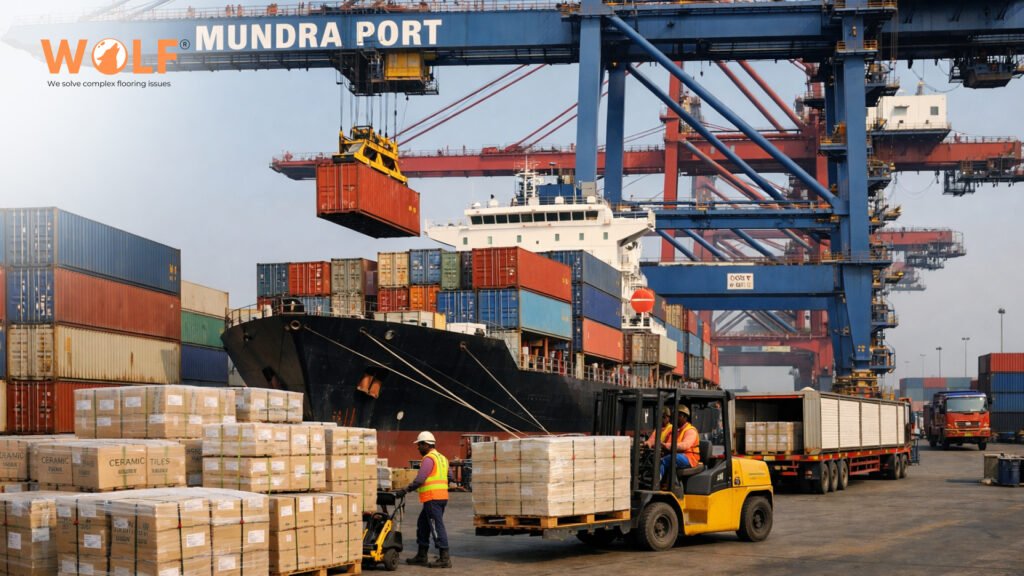
Shipping routes from Mundra Port, Gujarat to US East and West Coast ports support regular export planning for US-bound orders.
India has become a preferred alternative for many US importers, with tariff differentials making Indian sourcing more competitive on landed cost calculations. For US brands evaluating OEM partnerships, that tariff context is part of the cost equation alongside factory pricing and freight.
Key advantages of Morbi for US OEM programs:
Morbi’s manufacturing cluster offers what no single factory can: variety within a single sourcing geography. A US brand building a multi-format collection can work across sizes, finishes, and design specifications without managing relationships across multiple countries.
You can also explore our global export track record to evaluate long-term reliability across international markets.
So what actually separates a successful OEM partnership from a costly mistake? It starts with understanding the process end to end before committing to a manufacturer.
This decision shapes everything downstream. US brands need clarity on three things before approaching any manufacturer:
Being specific at this stage compresses development time and reduces sampling iterations considerably.
Explore our complete tile design collections as a starting reference for what is producible across formats and finishes.
From there, OEM programs allow:
Sample approval is the most important stage in the entire process. The approved sample is the production standard. US brands that rush sample approval to accelerate timelines create batch consistency problems that compound across every subsequent order.
This is where the product becomes the brand’s own. OEM programs allow complete specification of:
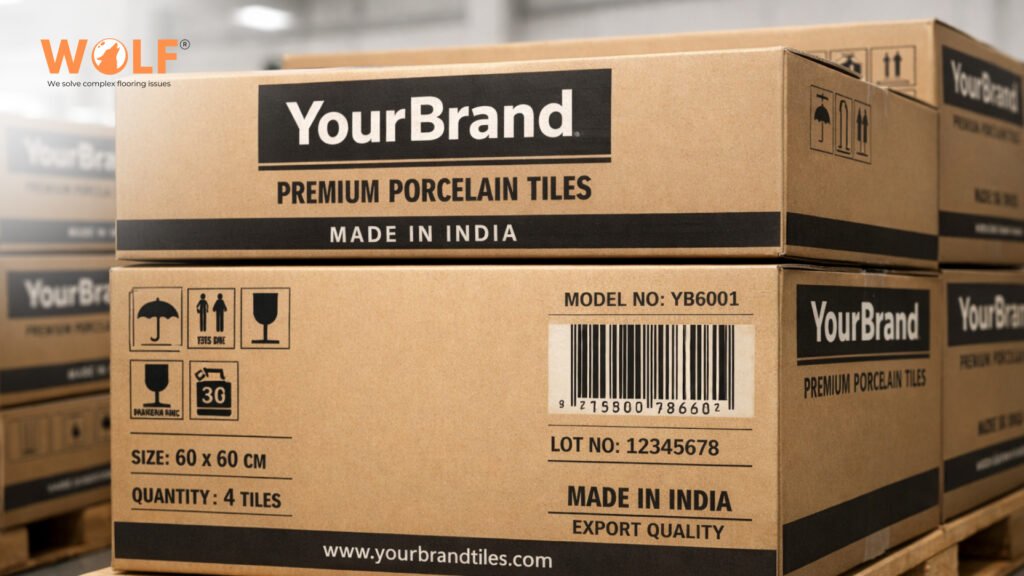
Minimum order quantities in OEM programs are structured around container economics.
A 20ft container is the most practical entry point for US brands beginning a private label program:
For 600×1200mm tiles, a 20ft container approximately holds 1,400–1,500 sqm, varying depending on tile size and thickness, making it a practical entry point for initial stocking and early project supply without overcommitting capital before demand is validated.
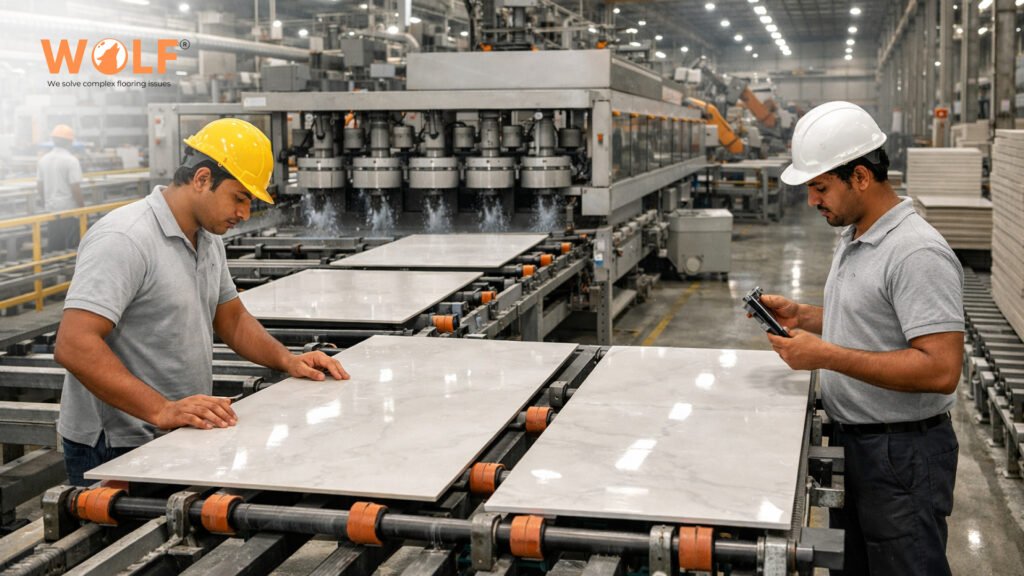
Production monitoring and pre-shipment inspection are where OEM partnerships earn their reliability.
Before the container is loaded, established manufacturers run:
For private label programs specifically, batch inconsistency is a brand problem, not a logistics problem. It is the US brand’s name on the box when a retailer compares two deliveries and finds visible variation.
Learn more about our quality team and export department to understand how quality verification is structured across international shipments.
Indian OEM manufacturers experienced in US export handle the complete documentation package:
Getting this package right prevents clearance delays that add cost and compress the timeline between order and revenue.
The first container is a validation exercise. The second and third containers are where the private label program becomes a business asset.
Experienced OEM partners build reorder systems around US brand seasonal buying windows, production slot availability, and transit scheduling to ensure supply continuity across sales cycles.
Format selection for a US private label program should be driven by where the market is going, not where it has been.
Explore 600×600mm porcelain tile collections
The 600×600mm format remains a widely used format across commercial and residential applications. It handles load distribution efficiently, works across a wide range of installation contexts, and moves reliably in both contractor supply and retail channels.
Best suited for:
Explore 600×1200mm porcelain tile collections
The 600×1200mm format is widely specified for modern residential and commercial interiors.
It works across:
For US brands targeting design-conscious residential buyers or the hospitality sector, this format is the priority SKU.
Explore 1200×1200mm large-format porcelain slab collections
The large-format slab market in the US has grown as open-plan residential design and premium commercial interiors have driven demand for seamless flooring results.
Best suited for:
For US brands building a premium tier within their private label program, the 1200×1200mm format creates clear visual differentiation that supports higher retail price positioning.
Finish is a brand positioning decision as much as an aesthetic one.
Matte finish aligns with current US residential design preferences, particularly in modern and natural material-focused interiors including kitchens and bathrooms. Matte also offers practical advantages in commercial settings:
Glossy finish serves premium residential applications and hospitality environments where reflectivity and visual impact are part of the design brief. US luxury residential buyers and hospitality designers continue to specify glossy for feature applications and wet rooms.
High Glossy finish can support premium retail positioning when paired with the right design and target segment. It delivers a visual result that sits at the upper end of the finish spectrum and suits brands building a clearly differentiated luxury tier.
The strongest US private label programs are built across at least two finish levels: a matte volume driver and a premium glossy or high-glossy statement tier, to serve multiple customer segments from a single brand architecture.
This is the concern most US brands raise and most OEM conversations underaddress.
Design protection works through a combination of contractual and practical measures:
The more practical protection comes from manufacturer selection itself. A manufacturer whose business model depends on building long-term relationships with serious US brands has strong commercial incentives to maintain design confidentiality.
A factory treating OEM as a secondary service line has weaker incentives and less robust systems. That distinction is not visible in a price quote. It is visible in export history, client references, and operational maturity.
So what actually determines whether an OEM partner delivers or disappoints?
The variables that matter are not visible in a price quote. They become visible across multiple orders over time, which is exactly why choosing wrong is expensive.
Evaluate potential OEM partners against:
Export-oriented manufacturers typically maintain dedicated quality and logistics teams to support international clients, which is a practical indicator of operational maturity worth confirming before committing to a partnership.
Working with manufacturers with extensive export experience across multiple international markets provides US brands with evidence that the process works at scale, across markets, and over time.
For context on how US distributors are currently sourcing large-format tiles directly from Indian manufacturers, the blog on how US tile distributors source large-format porcelain directly from Indian manufacturers provides relevant background on the current sourcing landscape.
OEM porcelain tile manufacturers in India for export are factories that produce tiles for international brands under private labels, handling production, customization, quality control, and global shipping. The US brand specifies design, packaging, and branding. The manufacturer typically handles production, quality checks, export documentation, and shipment coordination for port dispatch.
Evaluate manufacturers on export track record, batch consistency across multiple orders, US customs documentation accuracy, communication reliability during production, and production capacity that scales with brand growth. Price is the starting point of evaluation, not the endpoint.
Tile size, surface finish, design pattern, tone and texture calibration, carton design, logo placement, labeling language, and packaging structure. The extent of customization depends on the manufacturer's OEM capabilities and the order volume supporting the program.
MOQs are structured around container economics. A 20ft container is the most practical entry point. Exact quantities vary by tile size and finish, but container-level MOQs make private labeling accessible to serious mid-sized US brands without requiring industrial-scale commitments upfront.
Through pre-production sample approval, in-line production monitoring, pre-shipment batch inspection, and shade consistency verification before container loading. For private label programs, consistency across orders is a contractual expectation, not an optional quality level.
Through NDAs covering design specifications and customer information, US design registration where applicable, and manufacturer selection based on long-term export relationship track record rather than price alone.
Production typically takes three to six weeks depending on order volume and customization complexity. Ocean transit from Mundra Port to US East or West Coast ports varies by routing. Total lead time from order confirmation to US warehouse delivery, including production, quality verification, and shipping, typically ranges from eight to fourteen weeks for initial orders.
In a competitive US tile market, differentiation helps brands protect margin and avoid direct price comparison. Brands that own their product control their retail conversation and their customer loyalty in ways that resellers cannot.
Working with OEM porcelain tile manufacturers in India for export is the proven path to that position.
The manufacturing infrastructure to make that happen exists in India. The process is increasingly accessible to serious US brands. The gap between a brand that resells and a brand that owns its product is not capital or scale.
It is the decision to begin.
Schedule an OEM partnership consultation and get expert guidance on collection design, MOQ planning, and export logistics, built around your US brand’s specific requirements.