How Belgian Importers Can Verify Porcelain Tile Standards (EN 14411, CE, ISO)
January 2, 2026
Picture this: March 2024, Antwerp Port. A container of premium porcelain tiles, approx €48,000 worth, sits locked down. The tiles? Flawless. The problem? A notified body number on the CE marking that doesn’t exist in the EU database. One Belgian importer learned the expensive way that documentation beats product quality when customs comes calling.
Here’s what you need to know if you’re importing tiles to Belgium, explained in plain language, without the confusing technical stuff.
Why Belgium Takes Import Paperwork Seriously
Belgium isn’t just another European country that receives tiles. It’s the gateway. Tiles that land in Antwerp often get distributed to Netherlands, France, Luxembourg, and Germany. Because of this, Belgian customs act as the quality checker for multiple countries at once.
The numbers back it up: Belgium brought in about €289 million worth of ceramic tiles in the year 2023, more or less. Almost half came from Asia, especially India and China. That’s a lot of tiles and a lot of attention from customs officials.
So now what makes Belgium different from other countries?
The first thing is that they actually check your certificates. When you submit a lab test report, Belgian customs officers look up that laboratory in an official European database. They’re not just accepting your papers, they’re verifying them.
They want to know where tiles are really made. If your invoice shows a Delhi company but the tiles ship from a factory in Morbi, your paperwork needs to explain this clearly. They’ve gotten really strict about this.
Your supplier might make excellent tiles but not understand what Belgian customs expect to see on paper. That gap can cost you thousands, if your supplier does not understand that documentation isn’t annoying bureaucracy, it’s proof that quality actually happened.
Understanding the EN 14411 Standard
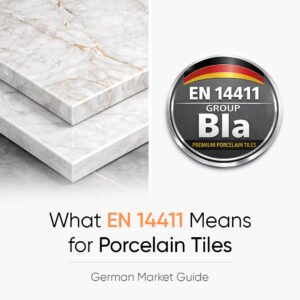
EN 14411 is the European standard that says what qualifies as good quality ceramic tiles. For porcelain specifically, you need something called “Group BIa” classification. This basically means the tile absorbs very little water which is less than 0.5%.
So now why does water absorption matter? Because tiles that soak up water can crack in cold weather or get damaged over time.
But here’s where people make mistakes: Just having an EN 14411 certificate isn’t enough. Belgian customs independently verify that your certificates are legit.
How to Check If Your Lab Certificate Is Legitimate
Every test report must show the laboratory’s name, location, and an accreditation number. Here’s what you do:
Make sure they’re actually allowed to test ceramic tiles
Check that their accreditation is still valid and not expired
Always save a screenshot for your records
Real story: A quality manager in Brussels once received a very impressive-looking, highly polished, test report from something called “European Testing Institute.” Sounded official. Five minutes of checking online? That lab doesn’t exist. The supplier had created fake test reports.
The Numbers That Actually Matter
When you look at test reports for porcelain tiles, these are the important numbers:
Water absorption: Should be 0.5% or less. Good manufacturers hit 0.2-0.3%, even better than the minimum.
Breaking strength: Should be at least 1300N (that’s a measurement of pressure). This tells you if tiles will crack under weight.
Size accuracy: Tiles should be within half a millimeter of their stated size. If they’re off by more, installation becomes difficult.
Indian manufacturers who invest in good equipment consistently hit these numbers. Wolf Group India, for example, has been making tiles for over 20 years using Italian machinery. Their water absorption typically tests at 0.18-0.25%, well below the limit. That safety margin matters when customs decide to spot-check your shipment.
Fresh Tests and Batch-Specific Proof
Here’s something most people don’t know: the test should be recent, ideally from the last two years. Why? Because factories change. They upgrade equipment, switch suppliers for raw materials, and improve processes. A test from 2021 doesn’t guarantee your 2025 order will be the same quality.
Even more important: ask for testing data from YOUR specific order. A generic certificate just proves someone tested something at some point. You need proof that YOUR batch, from YOUR production run, was tested and passed.
Let’s say you’re ordering 15,000 square meters of tiles. Your manufacturer gives this a batch number like “B-2025-034.” Good manufacturers test each batch separately and keep records. You should ask for:
The batch number
When it was produced
How many tiles were in that batch
Test results specifically for that batch
Temperature records from the kiln
Which raw materials were used
Wolf Group’s production system tracks all this automatically. It’s not special reporting, it’s just how they run their factory. So when Belgian customs ask questions about your batch, you have immediate answers.
Understanding CE Marking Made Simple
Anyone can print a CE mark. You could do it right now on your computer. What makes it legitimate is the paperwork behind it and that’s exactly what Belgian customs investigates.
The Declaration of Performance (Your Main Document)
Every tile product entering Belgium needs something called a Declaration of Performance. Think of it as a fact sheet that lists exactly what the tiles can do. It must include:
Who made the tiles (full company name and address, not just a trading company)
What the tiles are (size, type, intended use)
Specific performance numbers (how much water they absorb, how strong they are, how slip-resistant)
Which European standard they meet (should say EN 14411)
A four-digit number if a certification body was involved
Here’s a smart move: ask for this Declaration of Performance BEFORE you place an order. Look at whether it contains actual numbers and data, or just vague marketing language. A real one reads like a specification sheet. A fake one reads like an advertisement.
The Three-Minute Check That Saves Thousands
See that four-digit number next to the CE mark? You can verify it in three minutes:
Write down the four-digit number
Go to the NANDO database (ec.europa.eu/growth/tools-databases/nando)
Type in the number
Make sure the organization actually exists and is allowed to certify construction products
Confirm they’re authorized for ceramic tiles
Belgian customs regularly catch fake numbers. For instance, “2456” might look legitimate, but if it’s not in the NANDO database, that CE marking is fraudulent. Your whole shipment gets rejected.
A distributor in Ghent now checks these numbers for EVERY new supplier before even asking for samples. This three-minute check has saved them from four potential disasters in the past year and a half.
Indian Factory Documentation: What Belgian QC Teams Need
Indian manufacturers make great tiles. The challenge isn’t their capability, it’s making sure they provide paperwork in the format Belgium expects.
From Quality Department: Production batch records (raw material lot numbers, kiln temperature logs, in-process test results, equipment calibration records, non-conformance reports), laboratory test reports with accreditation proof, batch-specific results, current EN 14411 certificate, CE marking technical file index, ISO 9001 certificate with surveillance audit report.
From the Administrative Department: Commercial invoice meeting EU requirements, certificate of origin with signature and stamp, packing list with batch numbers and CE marking confirmation, Declaration of Performance for each product, manufacturer’s conformity statement.
Wolf Group India formats their documents to match what European importers need. After working with over 40 countries for more than 20 years, they know what Belgian buyers expect. Their Italian production equipment automatically generates quality data, testing happens throughout production because that’s how their systems work, not because customers demand it.
The Belgian Advantage
Belgium’s rigorous verification requirements protect you from competitors who cut corners. When you demonstrate thorough protocols to contractors, you differentiate immediately, you’re selling confidence that projects won’t face compliance delays.
A Brussels distributor’s pitch: “We only work with suppliers maintaining documentation systems meeting Belgian customs standards. Our shipments don’t get held. Our projects don’t face delays. That’s worth the slightly higher price.” They’re not the cheapest tiles in Belgium. They’re reliably available tiles with verified compliance. Contractors pay for that reliability
What Good Indian Manufacturers Look Like
The best Indian manufacturers understand that documentation isn’t just bureaucracy, it’s communication proving that quality happened.
Wolf Group India’s approach reflects this: their Italian-technology production lines generate quality data automatically. Testing happens at multiple stages because their systems are designed that way, not just because the European customers demand it. The documentation Belgian importers need exists because the quality systems creating it are genuine.
After supplying tiles to over 40 countries for more than 20 years, they’ve learned that markets with strict verification requirements become their best long-term partners. Why? Because customers in demanding markets appreciate manufacturers who make compliance easy rather than treating it as a favor. Look for such suppliers who generate documentation automatically through their quality systems, provide batch-specific data without being asked, maintain current certifications proactively, welcome questions about their testing procedures, and connect you directly with quality managers when needed.
The Price of Cutting Verification Corners
Most importers see Belgium’s strict checking as a headache. Here’s a different view: it’s actually protecting you from competitors who cut corners.
When you show Belgian contractors and distributors that you verify everything thoroughly, you stand out immediately. You’re not just selling tiles, you’re selling confidence that their projects won’t get delayed by compliance problems.
One distributor in Brussels used this sales pitch: “We only work with suppliers who meet Belgian customs standards properly. Our shipments never get held up. Our projects never face delays. That reliability is worth paying a bit more.”
They’re not the cheapest tiles in Belgium. They’re reliably available tiles that you can count on. Contractors pay extra for that because time is money in construction.
The Bottom Line
Tile standards verification in Belgium isn’t a bureaucratic obstacle, it’s professional discipline separating profitable importing from expensive mistakes.
The framework stands to qualify suppliers thoroughly before orders, verify quality during production, confirm import readiness before shipment, and maintain documentation systems that scale.
Indian manufacturers with genuine quality systems make this manageable. The documentation exists. Your job is knowing what to request and how to verify it properly.
Standards create trust. Verification proves that trust is deserved. Do it thoroughly, and you build a business that thrives on reliability while competitors struggle with compliance surprises.