
Close
So you’ve found a tile supplier in India. The pricing works, the quality looks right, the samples are good. Then someone on your team asks: do these tiles have CE marking?
And suddenly the conversation gets complicated.
It shouldn’t be. CE marking for porcelain tiles is a defined process with clear responsibilities on both sides. The confusion usually comes from not knowing who does what, and not knowing which documents you should be requesting before production starts. Get that part wrong and you’re dealing with customs delays, compliance gaps, and conversations with distributors you’d rather not have.
Here’s the honest version of how it works, and specifically where the importer’s responsibility begins.
Under the EU Construction Products Regulation (CPR 305/2011), porcelain and ceramic tiles cannot be legally placed on the European market without CE marking. That’s not a technicality you can work around. It’s the legal condition for market access across all EU member states.
What CE marking actually represents is a declared performance statement. It means the product has been assessed against European standards, the performance characteristics have been documented, and if a regulator, architect, or distributor asks for proof, it exists. In construction, that chain of accountability matters. Specifiers build it into contracts. Retailers and distributors ask for it at onboarding. You don’t want to find out it’s missing after a container has landed.
The stakes are real. Products without proper CE documentation can be blocked at customs, removed from sale, or trigger disputes with distribution partners. For companies building a private label tile brand in Europe, getting this sorted before the first order is considerably easier than fixing it under pressure later.
The standard that sits at the centre of porcelain tile CE compliance for EU markets is EN 14411, which aligns with ISO 13006. This defines how ceramic and porcelain tiles are classified and what performance thresholds they need to hit before they can carry CE marking.
A few things worth understanding when you’re evaluating supplier documentation:
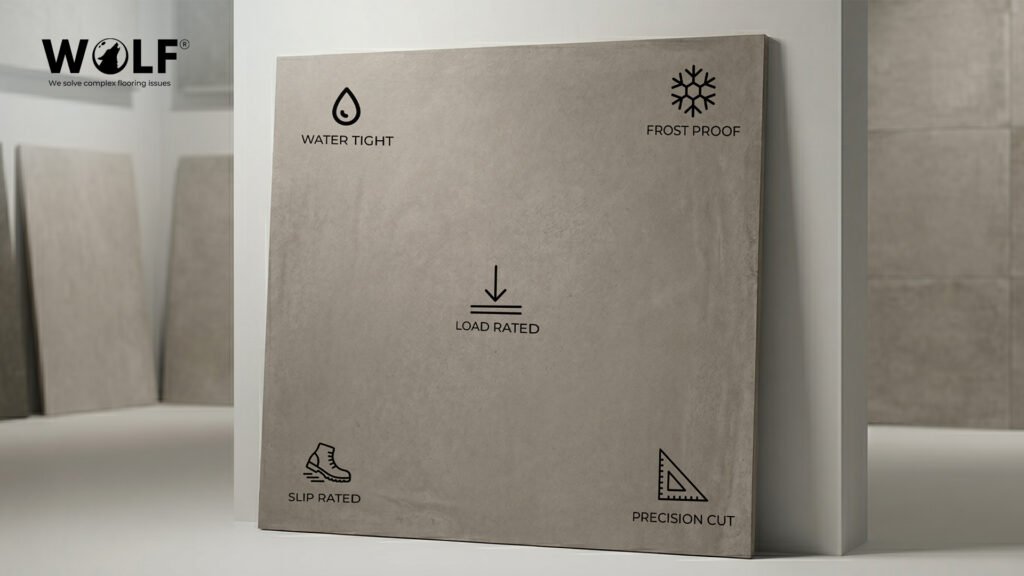
Water absorption is the characteristic that separates porcelain from ceramic. Full-body, dry-pressed porcelain made in Morbi typically falls into the BIa classification, meaning water absorption below 0.5%. That’s what makes these tiles suitable for wet areas, outdoor applications, and heavy commercial use. It should be stated explicitly in the test report, not just implied by the word “porcelain.”
Breaking strength sets a minimum load threshold. This matters most for larger format tiles going into floor applications. If you’re specifying 800x1600mm or 1200x1800mm formats, this figure needs to match your project specs.
Frost resistance is where Northern European buyers especially need to pay attention. A tile that performs well indoors can fail under freeze-thaw cycling outdoors. EN 14411 includes specific frost resistance classification and your test documentation should confirm this if the product is intended for any outdoor application in colder climates. This is the one characteristic most worth drilling into for markets like Germany, the Netherlands, or Poland. Ask for explicit test data, not just a general statement of compliance.
Dimensional accuracy covers thickness tolerances, flatness, and squareness. This one catches people off guard because a tile can pass every performance test and still create on-site problems if dimensional tolerances don’t match the installation requirements. Worth checking against your project specs early.
Slip resistance sits outside EN 14411 directly but comes up constantly in project specifications. Germany uses R-values, most other EU markets use PTV ratings. Ask about it early rather than late.
This is the question most procurement teams get wrong, and it’s worth being direct about.
The manufacturer, the tile factory in India, is responsible for testing the product, preparing technical documentation, and issuing the Declaration of Performance. That’s their role in the process.
The importer, the entity placing the product on the EU market under their own brand, carries responsibility for ensuring that what reaches the market is compliant. If you’re sourcing tiles under your own label and selling them to distributors or retailers in Europe, that responsibility sits with you.
That means you need to have seen the documentation before goods are shipped, not just been told it exists. You need to understand what the DoP covers and whether the declared performance characteristics match the markets and applications you’re selling into. If something is missing and goods are already in a warehouse, your options narrow considerably.
This is also why working with a private label tile manufacturing partner who understands European export requirements makes a practical difference. A supplier that has shipped to multiple EU markets knows exactly what a compliance-conscious procurement team needs to see.
When Wolf supplies tiles for European private label programmes, documentation is part of the sourcing conversation from the start. Here’s what’s available before you commit to a production run:
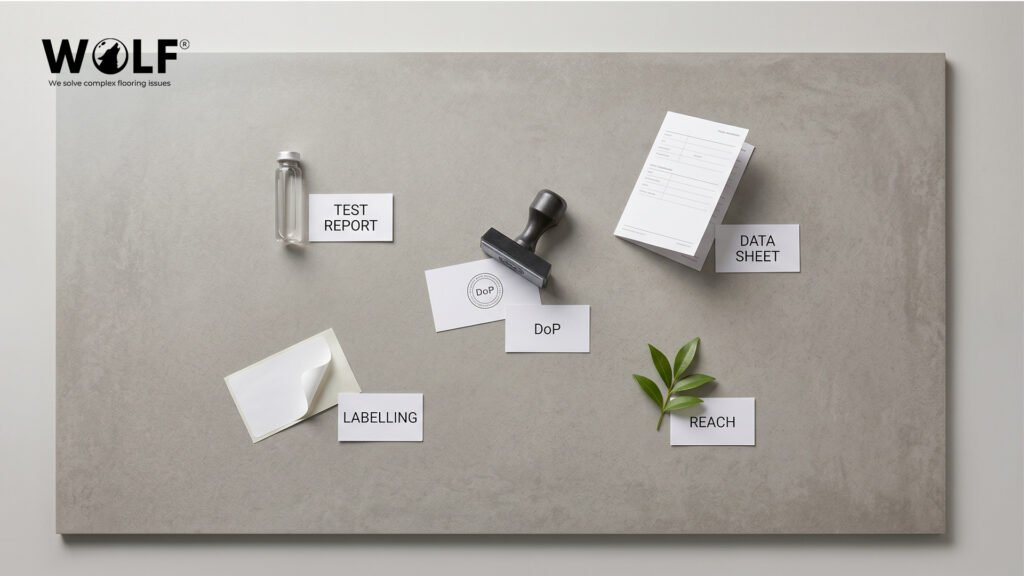
EN 14411 test reports from independent laboratories. These are the primary documents you reference when verifying product classification and performance characteristics. If you’re comparing suppliers, ask all of them for these before sampling, not after.
Declaration of Performance (DoP) templates so your team or legal advisors can review the format and declared characteristics before confirming an order. Some buyers want to see how the DoP is structured and what performance levels are declared before any production commitment. You can request a sample format at any stage of evaluation.
Product data sheets with full technical specifications per size and finish. Useful not just for compliance but for your own product listings, installer documentation, and project submissions.
Packaging and labelling guidance to make sure what arrives in the market is correctly identified. Labelling is part of the compliance picture and tends to get left to the last minute more often than it should.
REACH compliance declarations where applicable. For project types or markets where these are requested by clients or specifiers, supporting declarations can be provided.
You can review our certification and export credentials before starting your sourcing process, or read about Wolf Porcelain Tiles to understand the manufacturing and export setup.
Request a sample Declaration of Performance document for your review before you finalise your supplier shortlist. It’s a reasonable step and Wolf’s export team can turn it around quickly.
This is where a lot of importer guides get it wrong, so it’s worth being accurate.
Post-Brexit, Great Britain introduced UKCA marking as its own compliance framework. The original plan was to phase out CE marking for construction products by June 2025 and make UKCA mandatory. That deadline was revoked.
As of 2026, the UK government has confirmed CE marking is accepted indefinitely for construction products in Great Britain, following the Construction Products Amendment Regulations 2025.
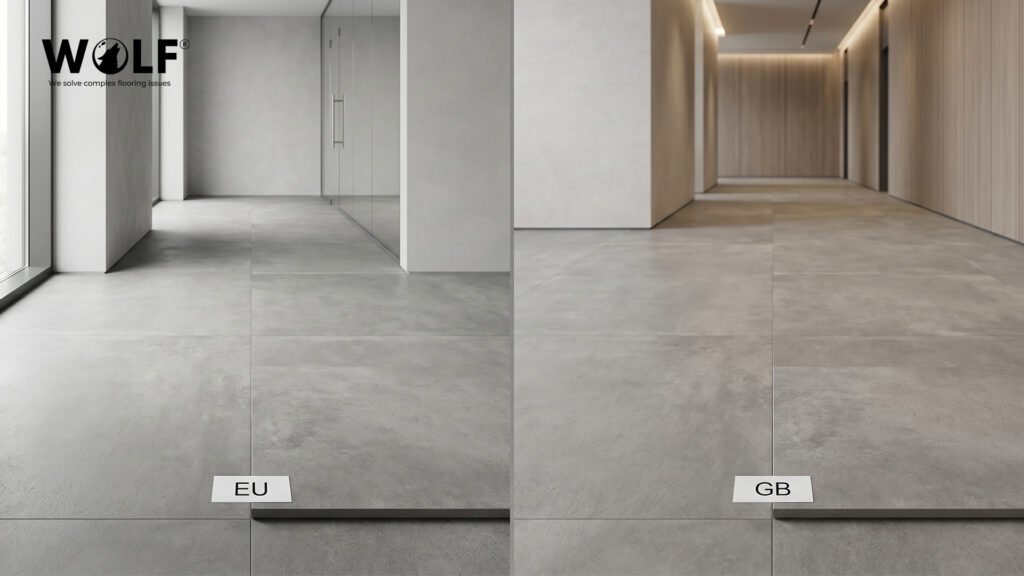
CE-marked porcelain tiles from India are currently fully valid for the GB market with no additional UKCA marking required. UKCA marking also remains valid and accepted, but it is not required if your products already carry CE marking.
The practical implication for importers supplying both EU and UK markets: CE documentation currently covers both.
That said, the UK government has signalled a longer-term regulatory reform process is underway, and the situation is worth monitoring. They’ve committed to a minimum two-year notice period before any future changes to CE recognition, so there’s no immediate pressure, but it’s not a question to ignore permanently either.
Northern Ireland is a separate case and continues to require CE marking specifically, which is already covered if you’re CE-compliant for EU supply.
Most compliance problems that cause delays or disputes aren’t about the product failing to meet standards. They’re about documentation gaps. Test reports that are outdated. A DoP that doesn’t cover the performance characteristics relevant to your target application. Labels that reference the wrong classification for a specific market.
These are all fixable before production starts. After goods land in a warehouse, fixing them means rework, renegotiation, or in the worst cases, products that can’t move until documentation is sorted.
Experienced procurement teams treat compliance documentation the same way they treat pricing and lead time. It goes into the supplier evaluation at the beginning, not as a box to tick at the end. If you’re building a private label tile programme for Europe and want to understand exactly what documents are involved, the time to ask is before you finalise your supplier shortlist.
For broader context on building a tile brand for EU markets, see our guide on private label porcelain tiles from India for European distributors. Or if you’re ready to start, request free samples to begin product evaluation, or contact our compliance team to discuss your documentation requirements directly.
Yes. Without it, tiles cannot be legally placed on the EU market. It's a requirement under CPR 305/2011, not a guideline.
It's the European standard that sets performance requirements for ceramic and porcelain tiles. Water absorption, breaking strength, frost resistance, dimensional accuracy. If your tiles carry CE marking, EN 14411 is what they've been tested against.
A document the manufacturer issues that formally states what the product's performance levels are. You need to see one before placing an order, not after.
The importer. The manufacturer provides the documentation. But the entity placing the product on the EU market under their own brand is responsible for ensuring it's compliant.
Many manufacturers in Morbi are. The key is asking for the actual test reports rather than taking compliance on trust.
EN 14411 test reports, a Declaration of Performance sample, product data sheets, and REACH declarations where your market requires them.
CE covers the EU. UKCA was introduced for Great Britain post-Brexit. As of 2026, CE marking is accepted indefinitely for construction products in GB, so both markets are currently covered by CE documentation alone.