Commercial Porcelain Tile Size Trends in Central America for 2026
June 19, 2026
Porcelain Tile Sizes for Commercial Projects in Honduras (2026)
If you’re procuring tiles for a commercial build in Honduras or anywhere in Central America, the same question keeps coming up: where do you get commercial-grade porcelain at a price that doesn’t blow the finished budget?
Regional distributors in Tegucigalpa and San Pedro Sula carry limited stock. What’s available is often priced for retail buyers, not for a 3,000 to 5,000 sqm commercial floor. So procurement teams in Honduras, Guatemala, and El Salvador are increasingly going direct, placing container orders from manufacturers in Morbi, India, and landing tiles at Puerto Cortés or Pacific ports for significantly less than equivalent products through US or European supply chains.
This blog is for buyers who are at that decision point. Which sizes work for which spaces. What specs actually matter for commercial use. How the logistics work from India to Honduras.
Honduras and Central America's Commercial Construction Market
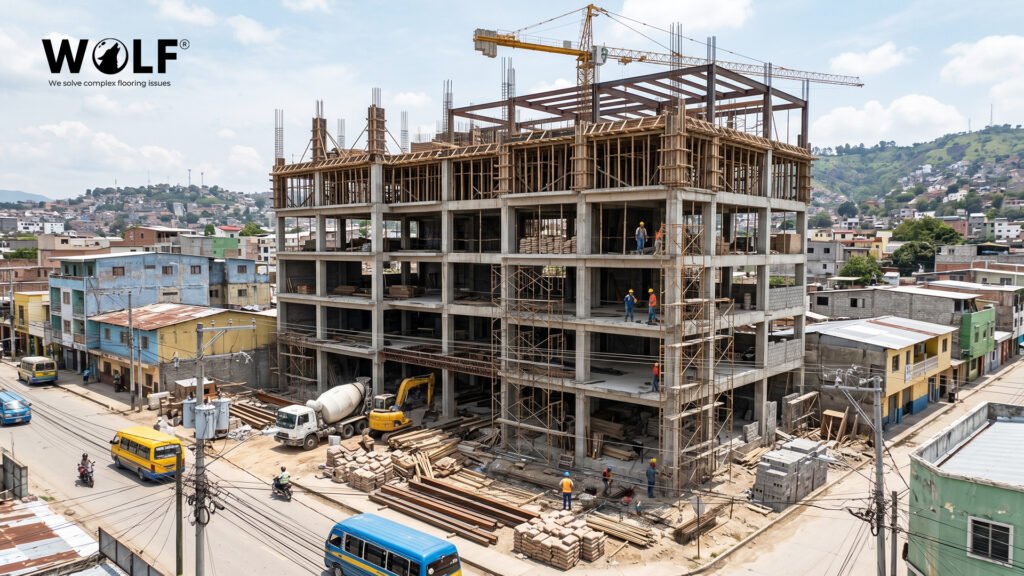
Commercial and institutional construction is active across Honduras and Central America heading into 2026.
Honduras has seen continued investment in commercial and institutional construction through 2025 and into 2026. Office parks, shopping centers, healthcare facilities, and government building programs across Tegucigalpa, San Pedro Sula, and secondary cities are all active. Guatemala City and San Salvador are driving similar demand.
Much of the finishing material for these projects already comes from outside the region. Demand for porcelain tiles across Central America is mostly met by imports, because local production can’t reliably meet the volume or specification range that large commercial jobs require. That gap is where direct import sourcing makes the most financial sense. Buyers who go direct to manufacturers avoid multiple distribution markups and have access to a far wider range of sizes and finishes than regional stock allows.
Why Indian Porcelain Works for High-Traffic Commercial Spaces
Commercial flooring takes a different kind of punishment than residential floors. A busy office corridor, a hospital entrance, a shopping mall floor. Thousands of people daily, years of use, cleaning with industrial floor machines. The tile has to hold up without chipping, staining, or losing grip.
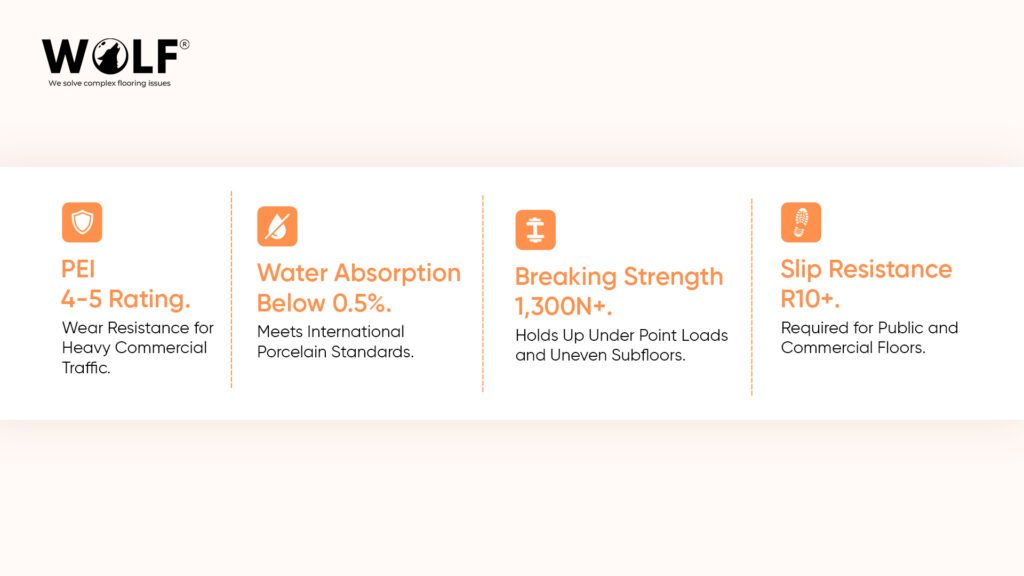
The specs that matter for commercial floor tiles in Honduras:
PEI 4 or 5 rating : PEI stands for Porcelain Enamel Institute wear resistance. PEI 5 is specified for the heaviest commercial and industrial use. PEI 4 covers most standard commercial applications including offices, hotels, and retail.
Water absorption below 0.5% : This is the international threshold for porcelain classification under ISO 13006. Below 0.5% means the tile body is dense enough to resist moisture penetration, critical for any ground floor, entrance, or external-facing area.
Breaking strength above 1,300 Newtons : Larger format tiles are at more risk of cracking under point loads on uneven subfloors. High breaking strength protects against that.
Slip resistance R10 or higher : R10 is the standard anti-slip rating required for public and commercial buildings. Matte surfaces typically achieve this; polished finishes are lower.
The four specs that matter most when sourcing commercial-grade porcelain tiles.
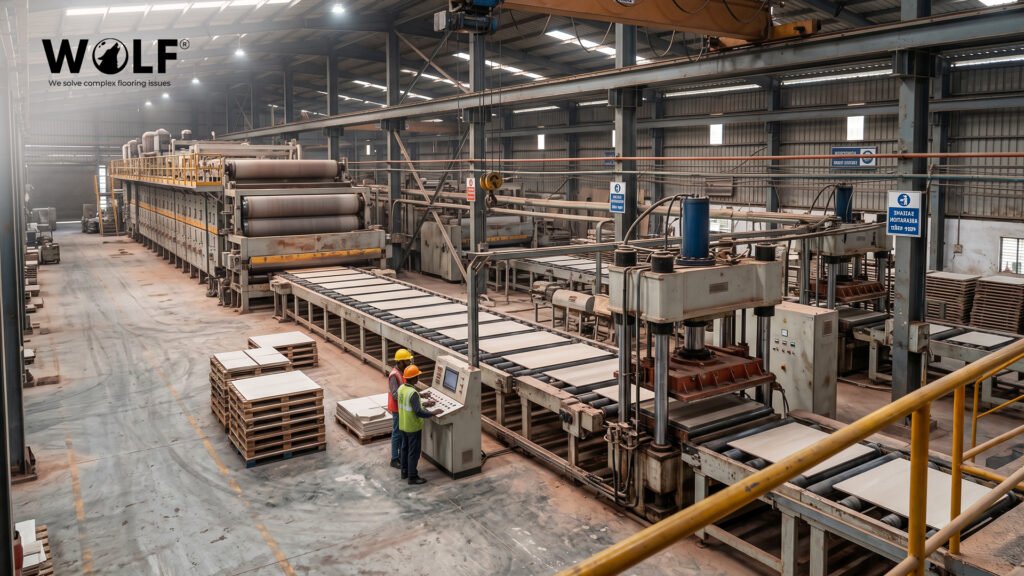
Indian manufacturers that produce for export meet these specs as a baseline because they’re selling to buyers in Europe, North America, and the Middle East who require documented compliance. Wolf produces its commercial range in Morbi using Italian press technology, which is what gives the tiles their dense, low-absorption body.
For total project cost, direct sourcing from India can deliver savings of 30 to 40% compared with equivalent products routed through US or European distributors. On a large commercial floor that difference is significant, and it’s one reason Indian tiles for Central American construction projects are increasingly appearing in procurement briefs.
Which Porcelain Tile Sizes Work for Commercial Spaces in Honduras
Tile size affects more than appearance. It affects installation speed, waste ratios, grout line frequency, and how easy maintenance is over the building’s life. Here’s how to spec by space type.
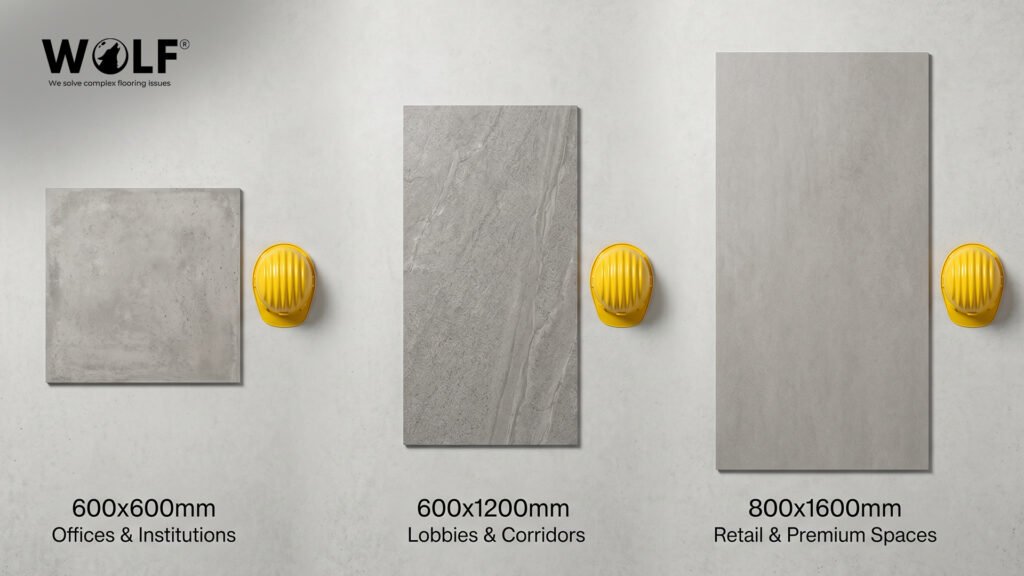
Three commercial tile sizes, each suited to a different type of space.
This is the most practical format for institutional and commercial builds. Easy for local installers to work with, manageable replacement if individual tiles get damaged, and proven across decades of heavy use in similar markets.
For offices, schools, government buildings, and healthcare facilities across Honduras and Central America, 600x600mm matte porcelain is the standard spec.
When the brief calls for something that reads as a step up without going full large format, 600x1200mm is the right call. Fewer grout lines, a longer visual run, and it handles both polished and matte finishes well.
Hotels, corporate headquarters, university atriums, and mixed-use retail ground floors all work in this format. Use polished finishes for lower-traffic reception and feature areas. Use matte for anything that gets daily machine cleaning.
For flagship retail, automotive showrooms, luxury hotel lobbies, and commercial atriums,800x1600mm large format tiles bring a scale that changes how a large floor reads. Fewer visible grout joints, more visual continuity. Premium commercial developments in Guatemala City and Tegucigalpa are increasingly specifying large format tiles for Honduras projects because of exactly that effect.
These tiles are heavier and need experienced installers, but for the right project they earn their place.
Finish Choice: Matte vs Polished
For heavy-traffic commercial floors, matte is the practical default. Better slip resistance, easier daily maintenance, and wear is less visible over time. For an in-depth breakdown of how matte and glossy perform in Central America’s tropical climate, thematte vs glossy guide for Guatemala covers this in detail.
Polished finishes suit feature walls, reception areas, and lower-traffic display spaces where visual impact matters more than daily maintenance performance.
How Importing Tiles From India to Honduras Actually Works
The process is more straightforward than expected, especially when working with a manufacturer that handles exports regularly. Tile importers in Honduras usually start with a single trial container before scaling to full project volumes.
Most container shipments from Morbi route through Mundra Port or Nhava Sheva, then move to Caribbean ports including Puerto Cortés, which is Honduras’s primary container terminal. Routing options vary by freight forwarder and current shipping schedules, so transit times can differ. Check current estimates with your forwarder before building a project timeline.
Standard documentation for import into Honduras includes commercial invoice, packing list, bill of lading, certificate of origin, and product technical specifications for customs clearance. Experienced exporters prepare all of this as standard.
Read aboutour export process and how container orders are managed from factory to port.
A note on import duty: ceramic and porcelain tiles entering Honduras fall under HS code 6907. Applicable rates are worth confirming with a local customs broker, as preferential rates may apply depending on the origin certification on your shipment.
Wolf's Commercial Collections
Wolf manufactures porcelain in Morbi, Gujarat for international export. The commercial range covers matte finishes, textured surfaces, high-gloss polished options, concrete-look designs, and stone-inspired collections across all major commercial formats: 600x600mm, 600x1200mm, 800x1600mm, 1200x1200mm, and 1200x1800mm.
Wolf's commercial porcelain range is manufactured at the company's facility in Morbi, Gujarat.
All commercial products are manufactured to the water absorption and wear resistance standards required for high-traffic institutional and commercial applications. Wolf exports to distributors and project buyers in 40+ countries, with active container exports to the Americas.
Whether it’s an office complex in Tegucigalpa, a retail development in Guatemala City, or a healthcare facility in El Salvador, getting the tile spec sorted early saves money and avoids delays.
Direct sourcing from manufacturers removes multiple distributor markups. Buyers typically see 30 to 40% cost savings versus equivalent products through US or European supply chains.
Order as soon as specs are confirmed. Factor in production lead time plus transit and clearance. Your freight forwarder can give you current estimates based on live schedules.
Matte handles daily use, cleaning, and slip resistance better. Polished works well for feature areas and lower-traffic spaces. TheGuatemala finish guide has a full room-by-room breakdown.
Distributors, procurement managers, and construction firms running commercial or institutional projects who need commercial-grade tile at container quantities. Not practical for small residential orders.