
Close
Most guides on this topic read like a checklist. Step one, step two, step three. Fine if you just want the bones of it, but if you’ve never bought a container of tiles from another country before, what you actually want to know is messier than that. You want to know what happens when something goes wrong. You want to know if the tiles in your hand will look like the photos. You want to know who you’re emailing at 11pm when a shipment is delayed.
So let’s talk about that instead.
We work with distributors and project suppliers across Europe and North America who’ve usually already done their homework. They’ve found a few Indian manufacturers, maybe gotten a price list, and now they’re stuck on the part nobody writes about clearly: how does this actually work, start to finish, and what’s the catch.
There isn’t really a catch. There’s just a process, and once you’ve done it once, it stops feeling like a leap of faith.
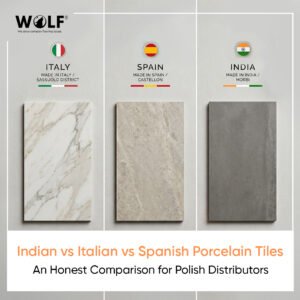
India is one of the largest porcelain tile producers in the world, and most of that output runs through one region: Morbi, in Gujarat. The cluster effect means hundreds of factories compete on the same street for the same buyers, which pushes pricing and finish quality in a direction that works for importers. For buyers in the Netherlands, Germany, the US, or Canada, that usually means a real cost advantage over Italy or Spain, plus large formats and certifications that have caught up fast.
At Wolf Porcelain Tiles, we’ve built our export operation around that gap, getting tiles into a European warehouse correctly documented and on schedule. Over 20 years and 40+ countries of export shipments later, that’s still what we focus on most (more on our about page). What keeps buyers coming back isn’t the first container, it’s whether the second one matches it.
This sounds obvious but it’s where a lot of inquiries go sideways. “Send me your catalog” gets you a catalog. It doesn’t get you a quote that’s worth anything.
What actually moves things forward is specifics: the sizes you’re after, whether you want matte, glossy, or textured finishes, roughly how much volume you’re planning (a trial order versus a full container makes a real difference in pricing), and whether the tiles are going into homes, commercial spaces, or a mix of both.
A lot of buyers gravitate toward 600x1200mm porcelain tiles for residential floors, and 800x1600mm large format tiles when the project calls for fewer grout lines and a cleaner look. If you’re not sure which fits your market yet, tell us the application and we’ll narrow it down from there.
Share your requirements with our export team → Request a Quote or Sample
Once we know what you’re working with, the next step is narrowing things down to a shortlist instead of handing you a hundred options and wishing you luck.
Here’s the part that matters most for first-timers: ask for physical samples before you commit to anything. Photos lie, not on purpose, but lighting and screens do strange things to color and texture. A sample in your hand tells you about edge rectification, surface feel, and whether the shade matches what you saw online.
You can browse what’s currently available in our porcelain tile collections before requesting samples, just to get a feel for the range.
If you’re building your own line rather than reselling under our name, this is the point to bring it up. Our private label manufacturing setup changes packaging and sometimes minimum quantities, and it’s easier to sort that now than unpick it later.
Want to see the tiles before you order? Request a free sample kit. Get Your Sample Kit
This is usually where the trust conversation happens, and it’s worth being direct about it instead of dancing around it.
You’ll get a quote that breaks down product specs, packaging, container capacity, and pricing under either FOB or CIF terms. FOB means we handle production and get the goods loaded at the Indian port, you arrange the ocean freight from there. CIF means freight and insurance to your destination port are already baked into the price. Most first-time buyers go with CIF because it’s one less thing to coordinate, but FOB can work out cheaper if you already have a freight forwarder you trust.
If you’re importing to Germany specifically and want the full cost breakdown with actual freight and duty numbers, we’ve laid that out separately in our Germany import cost guide.
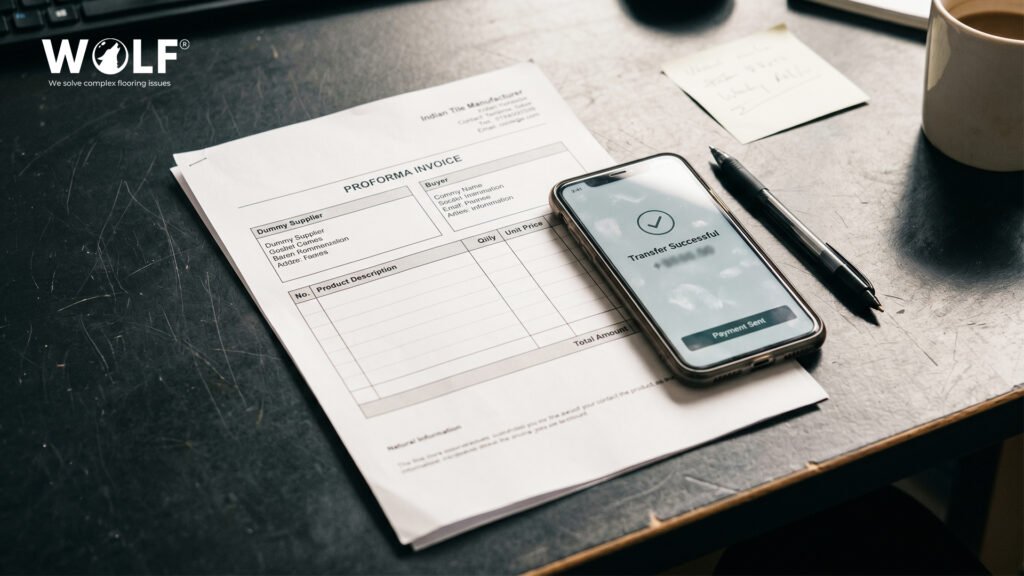
Once you’re happy with the numbers, we send a Proforma Invoice. Think of it as the agreement before the agreement: product details, payment schedule, banking info, and the production timeline, all in writing before anything gets made.
Payment is almost always TT (a straightforward bank transfer) or LC (a Letter of Credit, more common for larger first orders where both sides want extra security). Neither is unusual in this industry, and we’ll walk you through whichever one fits your comfort level.
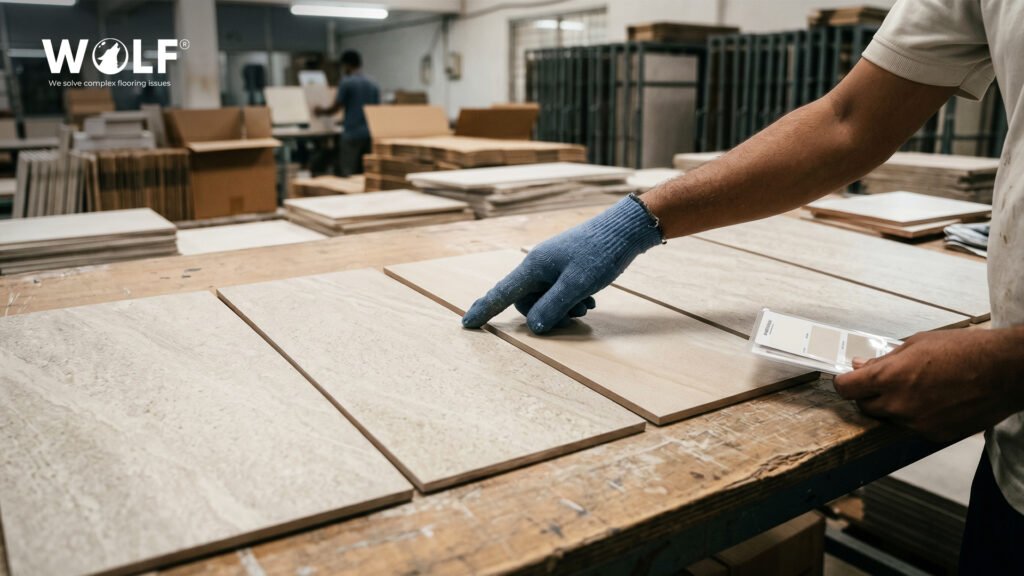
Production typically takes 20 to 35days depending on order size and how custom the specs are. During that window, the tiles go through size checks, surface inspection, and shade matching across the batch, because the worst outcome for everyone is a container where half the tiles are a slightly different shade than the other half.
Export-grade Wolf tiles carry ISO 9001 quality management certification and the CE marking required for EU commercial project specifications. Specific test documentation for your destination country is prepared before production starts, since requirements can shift slightly depending on where the container is headed.
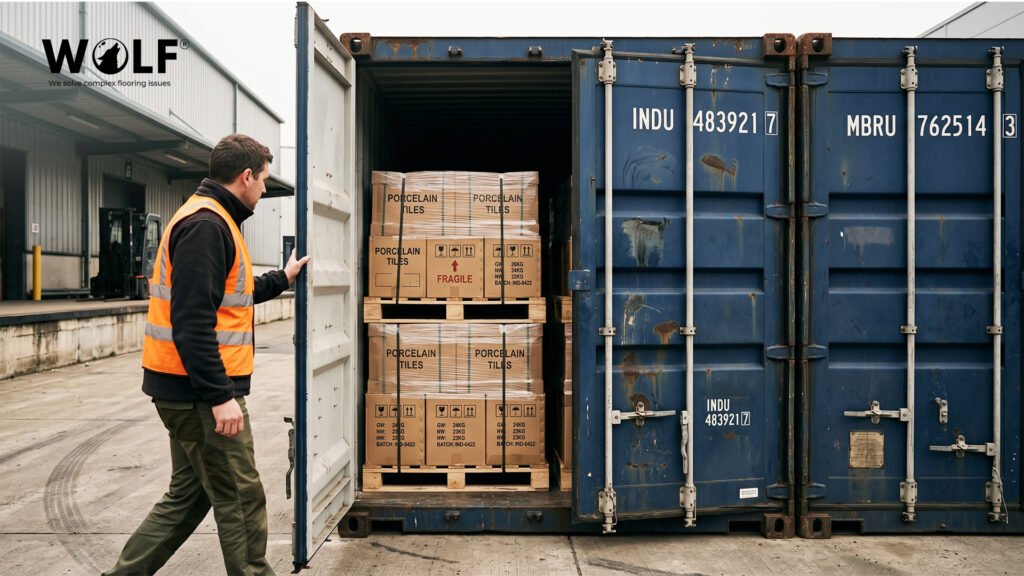
Loading the container is its own small art form. Porcelain tiles are heavy, and how they’re palletized and weight-distributed actually affects whether they survive the trip without chipped edges or cracked corners. We’ve written a full breakdown of how we handle this in our container loading guide, if you want to see exactly what the process looks like before your order ships.
Once the container leaves port, the conversation shifts to paperwork, and this is the stage that actually determines whether your shipment clears customs without delay.
You won’t be generating these documents yourself, but you will need to check them. The Commercial Invoice and Packing List confirm what’s in the container and what it’s worth for customs purposes. The Bill of Lading is your proof of shipment and the document your freight forwarder needs to release the goods. The Certificate of Origin confirms the tiles were made in India, which matters for duty calculations in some markets.
On top of that, your destination country may require specific compliance paperwork, and we prepare that alongside the rest once we know where the container is headed.
We cover the markets we ship to and how documentation differs by destination in more detail on our export process and reach page, worth a look if your country has specific import rules you want to check in advance.
Once the container clears customs at your end, duties get processed, the container gets released, and it lands at your warehouse. That’s the last step.
Not once you’ve been through it. The first time always feels like more is at stake than it is. The process itself is five things happening in order: you tell us what you need, we send samples, we agree on pricing and terms, production happens with checks along the way, and the container ships with proper documentation.
Ready to place your first order? Our export team responds within 24 hours, fill out the inquiry form or message us on WhatsApp
Request pricing or samples → Start Your Inquiry
Send your size, finish, and quantity requirements through our inquiry form or WhatsApp, and we'll recommend collections that fit before you commit to anything
Production runs 25-35 days, then add shipping time based on your country. Most European and North American orders land within a known, predictable window once production starts.
Yes, and you should ask for them. Physical samples catch color and finish issues that photos miss every time.
Under FOB, we handle production and loading at the Indian port, and you arrange the ocean freight from there. Under CIF, freight and insurance to your destination port are already built into the price. CIF is simpler for first-timers, FOB can work out cheaper if you already have a trusted freight forwarder.
Commercial Invoice, Packing List, Bill of Lading, and Certificate of Origin, plus anything specific your country requires. Your supplier should prepare most of this for you.
Yes, Many export-focused manufacturers in Morbi hold the certifications EU customs require, including ISO 9001 and CE marking, but confirm which specific standards apply to your country before production starts.
Yes, this is normal. Most export-focused manufacturers are set up specifically to guide first-time buyers through it.