
Close
The short version: To import porcelain tiles from India to Poland, shortlist a Morbi factory with real European export experience, approve physical samples, lock your specification in writing, arrange a pre-shipment inspection, then ship by sea to Gdańsk or Gdynia. Budget several weeks of transit and check the current EU anti-dumping duty on Indian tiles with your customs broker before you order. The rest of this guide walks through each step.
Most Polish distributors don’t hesitate over India because of the tiles. They hesitate because they’ve never run the import themselves and aren’t sure what the process looks like. Fair enough. Sending money halfway across the world for a container you haven’t seen feels like a leap the first time.
You already know Indian porcelain costs less than Italian. If you want that head-to-head, we covered India vs Italy vs Spain for Polish distributors separately. This guide is the part nobody explains properly: how an importer actually gets a container of porcelain from a factory in Morbi to a warehouse near Gdańsk, start to finish.
Morbi is a town in Gujarat, western India, and it’s the largest tile manufacturing cluster in the world. Somewhere between 700 and 1,000 factories sit within roughly a 30 kilometre radius, along with the glaze makers, printing suppliers, and logistics firms that feed them. That density is why lead times and pricing work the way they do. When you want a specific finish or a glaze tweak, the whole supply chain is on the same road.
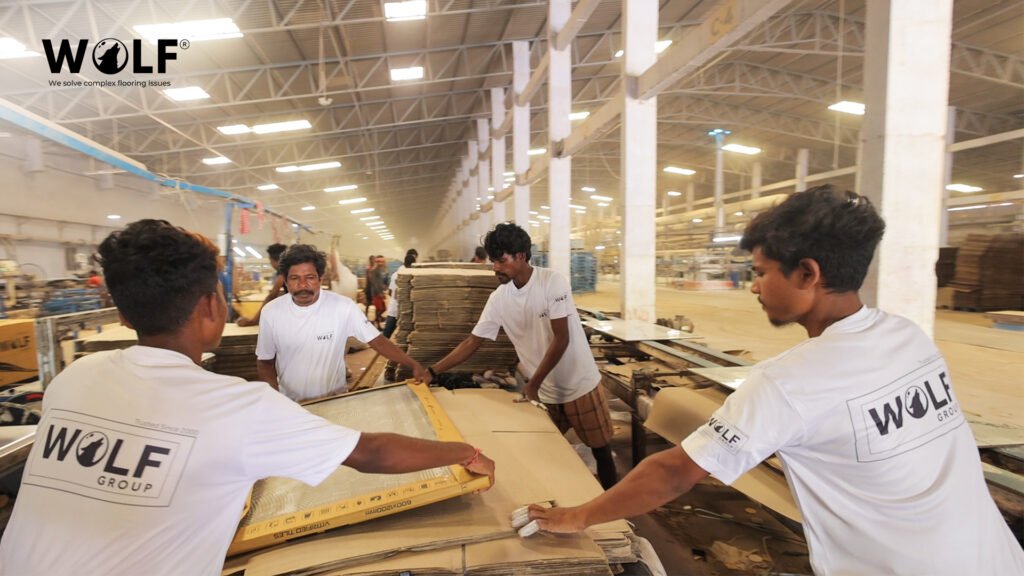
For a Polish buyer, that means a wide product range at a low unit cost. What first-time importers underestimate is how much the buying process decides whether those advantages actually reach your warehouse. Get it wrong and you lose the saving to delays and batch mismatches.
The cheapest quote in your inbox is rarely the one you want. The price is easy to put on paper. Holding shade and calibre across six months of containers is the harder test.
Look for a manufacturer that already exports to Europe, holds the certifications your customers ask for, and runs its own production rather than reselling other factories’ stock as a trader.
Ask three plain questions. Which product standards and conformity marks do your export tiles carry? Can you send technical data sheets and recent test reports? Can you show me European export references? If the answers come back slow or vague, move on. Wolf Group has exported porcelain from Morbi to 40-plus countries for over two decades, which is the kind of track record a Polish distributor should treat as the baseline.
See how our pricing compares to your current Italian supplier. Request a Poland-specific quote.
Never approve a container off a photo. Order physical samples and put them in front of your team.
Check the things a picture hides: shade consistency across pieces, surface finish, edge quality on rectified tiles, and how tight the actual dimensions are. This is also where you confirm the finish suits Polish conditions. Porcelain’s low water absorption is what lets it survive freeze-thaw winters, so if you’re supplying outdoor or terrace projects, verify it here rather than on site
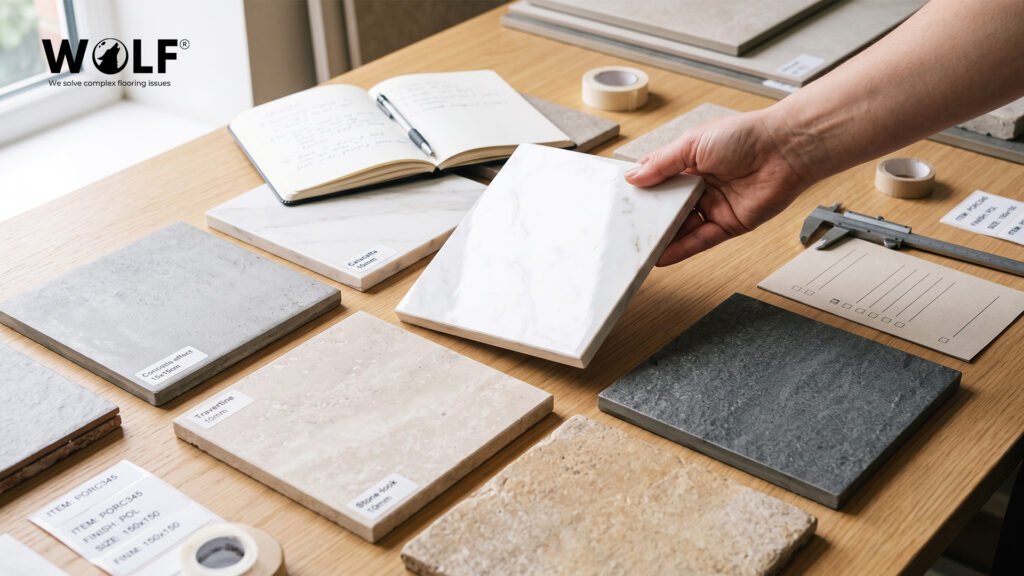
Sizes for the Polish market lean large-format. The 600×1200mm range has been the fastest mover for modern residential and commercial work, and it’s a sensible first test order. For premium and commercial specs, the 600x600mm standard size is worth sampling alongside it.
Once samples are approved, pin down every detail before production starts: sizes, finishes, thickness, packing, quantity per container, and the production timeline. Vague briefs are where delays are born.
Experienced importers insist on same-batch production for the full order. Tiles from different runs can vary in shade and calibre even when the design is identical, and you find out when the second pallet opens on site. Ask for one lot across the order, and ask for pre-dispatch photos of the loaded pallets.
Good export factories run quality checks at every batch, not only at sampling. Before the container is sealed, you want written confirmation that shade and calibre are uniform across the whole order.
If you can’t visit in person, ask for pre-shipment inspection photos or video of the full pallets. Reputable Morbi exporters are used to this and won’t push back. If a supplier resists showing you the loaded goods, treat that as your answer.
Containers leave from western Indian ports, usually Mundra in Gujarat, one of India’s largest ports and among the closest to Morbi. From there, sea freight carries the goods to Gdańsk or Gdynia, depending on the route.
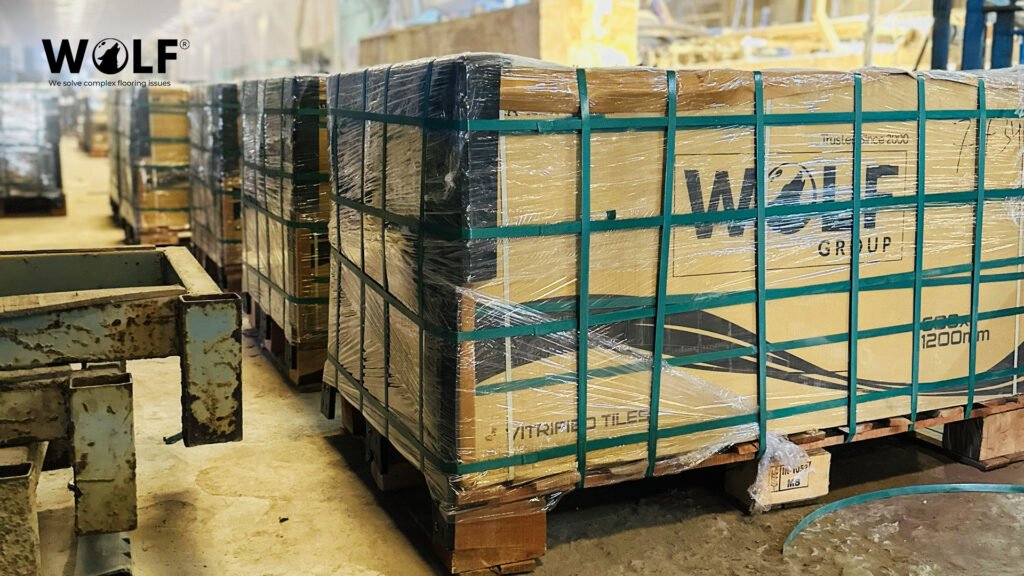
Transit takes several weeks once production is complete, so plan inventory around that window rather than ordering reactively.
A decent exporter prepares the paperwork for you: commercial invoice, packing list, bill of lading, certificate of origin, and product test reports where your customers or customs require them. You can read how we handle this on our export process page.
Here’s the part that’s easy to get wrong, and getting it wrong costs you money.
The India–EU Free Trade Agreement was concluded on 27 January 2026 in New Delhi, after nearly two decades of talks. It still has to clear ratification, so it needs approval from the Council of the EU, consent of the European Parliament, and approval on the Indian side before it takes effect.
The trap is assuming this deal lowers the cost of your Indian tiles landing in Poland. It doesn’t, and it’s worth understanding why. The FTA’s tariff cuts on ceramics are written to help European ceramics enter the Indian market, not the reverse. The charge that actually governs the cost of Indian tiles arriving in the EU is a separate anti-dumping duty of roughly 6.7% to 8.7%, confirmed as still in force by the Commission as recently as January 2026. That duty protects EU tile producers, including the major industries in Spain, Italy and Poland, and the FTA does not remove it.
So the honest advice is this. Don’t price your import assuming duties are about to vanish. Confirm the current anti-dumping classification and rate for your specific product with your customs broker before you place an order. It’s a real cost, it’s manageable, and India still competes well on total landed cost once you account for it, but only if you plan for it up front.
Poland isn’t unusual here. Distributors across the Czech Republic and Slovakia are running the same maths and the same process, which is why a porcelain tile manufacturer in India serving Eastern Europe tends to see these markets move together. The reasons are consistent: better margins, a wider range, and factories that hold quality across repeat containers. If you supply Polish projects specifically, we go deeper on that in direct-from-Morbi tiles for Polish projects.
The buyers who do well with India invest a little time upfront, get their inspection process right, and confirm their duties before ordering. Get those three things sorted and importing from Morbi becomes routine.
Ready to run your first container? Request samples shipped to Poland and check the quality in your own hands before you commit.
An established Morbi manufacturer with European export references, proper test documentation, and its own production rather than a trader reselling other factories' stock.
Commercial invoice, packing list, bill of lading, certificate of origin, and test reports where required. A good exporter prepares these for you.
Sea freight from western Indian ports to Gdańsk or Gdynia takes 55 to 60 days after production finishes, so plan inventory around that lead time.
Most shipments land at Gdańsk or Gdynia, depending on the shipping line and route.
Their low water absorption resists freeze-thaw cracking, which suits Polish winters and outdoor use.
Large-format porcelain such as 600×1200mm is the strongest mover for modern residential and commercial projects.
No. The FTA concluded in January 2026 mainly cuts duties on EU goods entering India. Indian tiles arriving in the EU still face a separate anti-dumping duty of about 6.7% to 8.7%, which the FTA does not remove. Confirm your rate with a customs broker.