
Close
If you import porcelain tiles into Europe, 2026 may be the year that changes your cost structure permanently.
On 27 January 2026, the European Union and India concluded negotiations on a long-awaited Free Trade Agreement. The agreement text is currently undergoing legal review, with EU legal scrutiny expected to conclude by July 2026. Formal ratification by both parties will follow, entry into force is anticipated in early 2027, though ratification timelines carry some risk of delay.
For tile importers, distributors, and procurement teams across Germany, Netherlands, Belgium, Poland, and France, this matters more than most trade news. Even a modest reduction in duty rates has a material impact when importers are moving multiple containers each month. For companies already sourcing from India, this improves margins. For buyers still relying on Spain, Italy, or Turkey, it may be the push to finally diversify.
If you’re evaluating a reliable porcelain tile manufacturer in Morbi, this agreement is worth understanding in full, before your competitors do. For context on how this compares to recent developments in other markets, see our overview of the US tariff impact on Indian tiles.
The India-EU Free Trade Agreement is a comprehensive bilateral trade deal concluded on 27 January 2026 in New Delhi, the largest FTA either party has ever signed. It covers goods, services, investment, and government procurement, and for tile sourcing from India, the goods element is what matters.
The agreement is designed to give the large majority of Indian goods preferential access to EU markets. Once ratified, it will reduce or eliminate import duties on a large share of Indian goods entering EU member states.
This is what European porcelain tile importers need to know.
Porcelain tiles fall under HS heading 6907. Today, standard EU customs duties on these products are generally around 5% MFN. According to a 2026 response from the European Commission, these duties will be lifted at entry into force of the FTA or phased out over up to five years depending on the specific tariff line.
Here is what that means in real numbers.
Say you import one container of porcelain tiles valued at €40,000.
(Container value used for illustration. Actual savings depend on product value, applicable duty rate, and individual manufacturer’s anti-dumping duty status.)
For distributors and wholesalers operating on tight margins, €100,000 in annual savings is a material improvement to your P&L, without changing a single product in your range.
Indian porcelain tiles are currently subject to EU anti-dumping duties ranging from 6.7% to 8.7%, depending on the manufacturer. These were introduced in February 2023 and remain in force independently of the FTA.
The FTA does not automatically remove anti-dumping duties. These are separate trade instruments and must be addressed through a different legal process. Your landed cost calculation must still account for:
For a full breakdown of how these costs stack up market by market, our guide on the cost of importing tiles to Germany walks through each cost line in detail.
Want to know exactly how much you could save per container under the India-EU FTA? Request a tariff-adjusted quote from Wolf.
For European buyers considering tile sourcing from India, preferential tariffs, the reduced or zero-duty rates, do not apply automatically to all Indian tile manufacturers and exporters. The product must meet the agreement’s rules of origin to qualify.
In plain terms: the tiles must genuinely originate in India, meaning they were substantially manufactured there rather than merely assembled or re-exported through India from a third country.
For porcelain tiles manufactured by a Morbi tile manufacturer, this is typically straightforward. The full manufacturing process: pressing, firing, rectification, surface finishing, and packing, occurs in India using Indian raw materials. This satisfies the “significantly processed” threshold without complexity.
The India-EU FTA uses a self-certification system. Rather than requiring a government-issued certificate for every shipment, exporters provide a statement on origin as part of the commercial documentation and upload it to a designated portal.
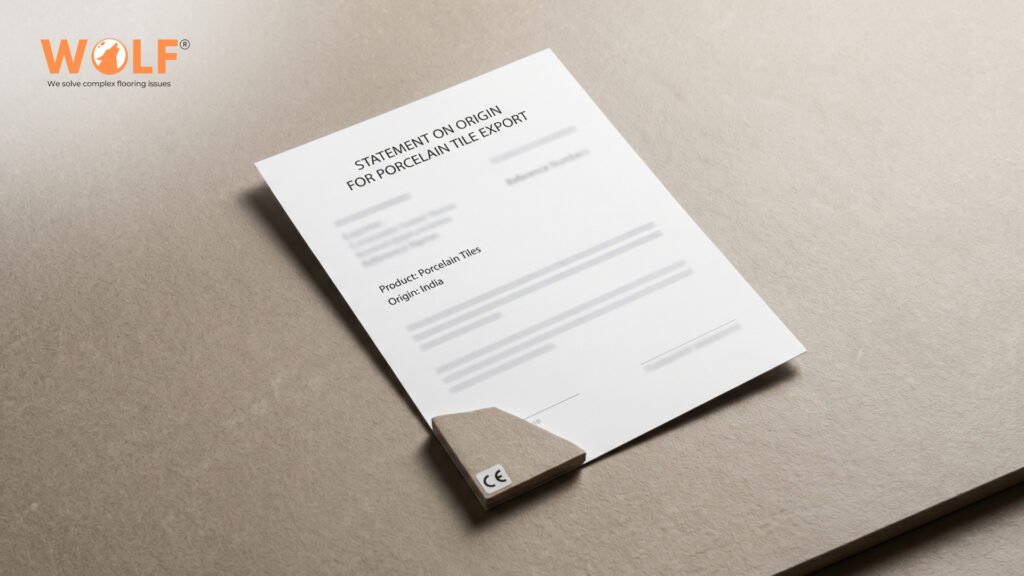
Your standard export documentation set will include:
For a full overview of what European customs teams require at import, see our page on export certifications and compliance. You should also review CE marking compliance for European tiles before placing commercial orders, CE marking is a product-level requirement independent of the FTA and remains mandatory for tiles entering most European markets.
Many European procurement teams are asking this, so it deserves a direct answer.
CBAM currently applies to six sectors: cement, steel, aluminium, fertilisers, electricity, and hydrogen. Ceramic and porcelain tiles are not directly covered by CBAM at this time. Tile importers do not currently need to file CBAM declarations for porcelain tiles entering the EU. You can verify the current CBAM sector scope on the European Commission’s official CBAM page.
That said, sustainability expectations from European buyers are increasing year on year. Procurement teams now routinely ask for data on energy sources used in manufacturing, emissions reduction practices, recycling systems, and environmental certifications, even when there is no legal obligation to provide them.
The India-EU FTA includes a cooperation element covering climate and clean energy, with EUR 590 million in EU support for India’s emission reduction efforts. If your procurement policy requires environmental data from suppliers, a serious Indian exporter will be able to provide it.
Waiting until the FTA is fully ratified and in force sounds logical. In practice, buyers who wait tend to benefit least.
When tariffs drop in early 2027, buyer interest in tile sourcing from India across Germany, Netherlands, Belgium, Poland, and France will increase sharply. Suppliers with proven export capability and established European client relationships will face higher demand. Production schedules will fill. Lead times will lengthen. The best pricing, negotiated before demand spikes, will already be locked in by buyers who moved earlier.
The window to establish a supply relationship on favourable terms is open right now.
If you are developing a proprietary collection, private label manufacturing for Europe becomes significantly more attractive once tariff reductions take effect. You can also review our container loading guide for Europe to plan order quantities per shipment.
Don’t wait for ratification. Build your supply chain now and be ready when reduced duties arrive. Request samples and pricing today.
Wolf Porcelain Tiles is based in Morbi, Gujarat, the world’s largest porcelain tile manufacturing cluster.
We have been exporting to international markets for over 20 years, supplying distributors, wholesalers, and project buyers across 40+ countries including active distribution relationships in Germany, the Netherlands, Belgium, and Poland. Our European clients include large-format tile distributors who use Wolf as their primary Indian supply partner for rectified porcelain collections.
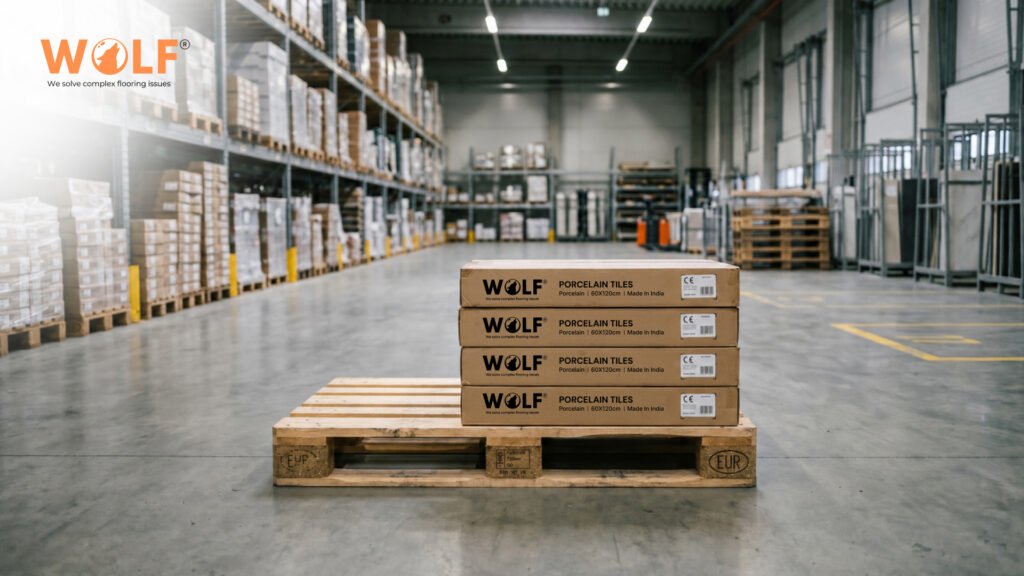
Our large-format porcelain tiles, including 600×1200mm and 800×1600mm formats, carry CE marking and are manufactured under ISO-certified processes. When the Netherlands distributor for one of our private label collections placed their first container order, full CE documentation and export compliance paperwork were prepared and delivered before the vessel departed Mundra port. When the India-EU FTA enters into force, our export team will be ready to prepare FTA-compliant statements on origin from day one, so your team can claim preferential tariff treatment immediately.
European buyers sourcing through Wolf benefit from:
To learn more about our manufacturing and export capabilities, visit our About page.
Ready to leverage the India-EU FTA for your tile sourcing? Request free tile samples or contact our export team to discuss FTA-optimised pricing for your market.
Reach us directly on WhatsApp: +91 97122 33215
The India-EU Free Trade Agreement 2026 is one of the most consequential trade developments for the porcelain tile industry in recent memory.
For European importers, the headline benefit is clear: lower duties on Indian porcelain tiles reduce landed costs and improve margins. But the companies that benefit most will not be those who act after ratification. They will be the buyers who shortlisted suppliers, tested products, and built sourcing relationships while competitors were still waiting.
If the 2027 sourcing strategy is on your agenda, the conversation with Indian manufacturers should start now.
It can reduce or eliminate EU customs duties on Indian ceramic and porcelain tiles once the agreement enters into force, directly reducing landed costs for European buyers.
The agreement was concluded on 27 January 2026 and is expected to enter into force after legal review and formal ratification by both parties, likely in early 2027.
No. The FTA does not automatically remove existing anti-dumping duties. These remain in force as separate trade instruments and vary by manufacturer.
Yes, provided they meet the rules of origin requirements and the exporter provides the correct documentation, including a self-certified statement on origin.
No. Ceramic and porcelain tiles are not currently included in the scope of CBAM.
A buyer importing €40,000 of tiles per container could save approximately €2,000 per container if a 5% duty is eliminated. At 50 containers per year, that is €100,000 in annual savings.
Early movers secure better pricing, establish reliable supplier relationships, and have tested logistics and documentation in place before demand for Indian tiles increases post-ratification. Contact Wolf to begin the process.