How to Import Porcelain Tiles from India to Serbia: A Distributor’s Guide for 2026
September 15, 2026
If you’re planning to import porcelain tiles from India to Serbia for the first time, there’s one thing worth knowing before anything else. Sitting outside the EU customs union works in your favour on duty, and we’ll get into exactly how much further down.
For now, here’s the full process: Finding the right manufacturer, routing the container, what duty and VAT actually look like, and where Wolf fits in as a partner rather than just a supplier.
Step 1: How to find a Morbi porcelain tile manufacturer
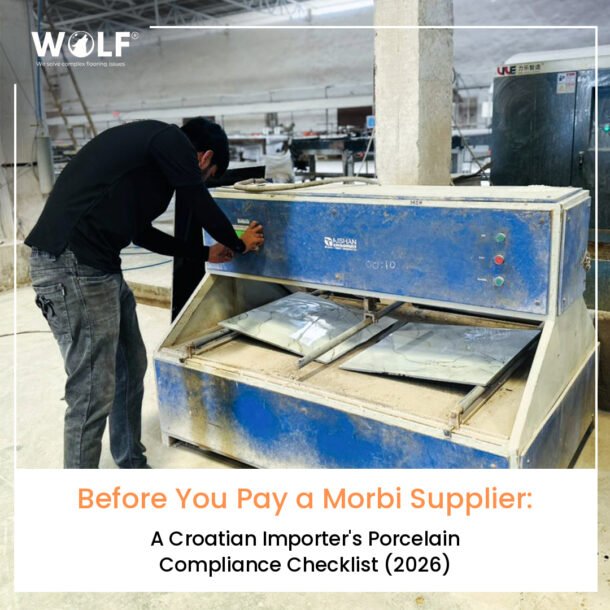
Morbi in Gujarat is where most of India’s porcelain comes from, but there’s a real difference between buying from the factory itself and buying through a trading company that sources across several factories. That difference shows up on container three, when your “consistent” order suddenly isn’t. Wolf quotes as the manufacturer directly, so the grade you saw in the sample is the grade that ships every time. SeeWolf’s export capability for how that works in practice.
Inside the production floor of a Morbi porcelain tile manufacturer
Step 2: How to choose a porcelain tile exporter from India to Serbia
An exporter who ships well to Germany or France isn’t automatically good at shipping to Serbia. The documentation is different because you’re clearing a non-EU border, not an EU one, and the clearance path follows different rules entirely. Wolf builds Serbian-specific paperwork for every shipment into this market, rather than adapting an EU template after the fact and hoping customs accept it.
Step 3: Samples and quality checks before you import porcelain tiles from India
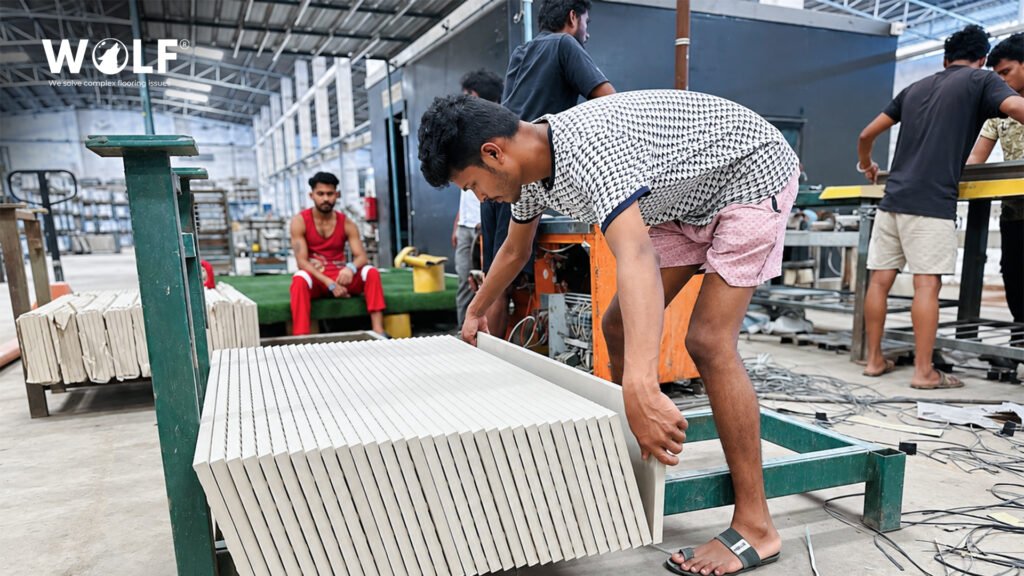
Get physical samples on the sizes you actually plan to stock before any container gets ordered, not just whatever’s sitting in the catalogue. Check shade consistency across pieces, surface finish, edge rectification, and how the packaging holds up, then keep a set on file so you have something to compare the real shipment against when it lands. Wolf sends three free samples of your intended sizes, packed the same way a full order would be, so what you check is what you’ll actually receive.Request three free samples to get started.
Checking shade and finish across sample porcelain tiles before placing a container order
Step 4: Specifications, MOQ and terms from a Morbi porcelain tile manufacturer
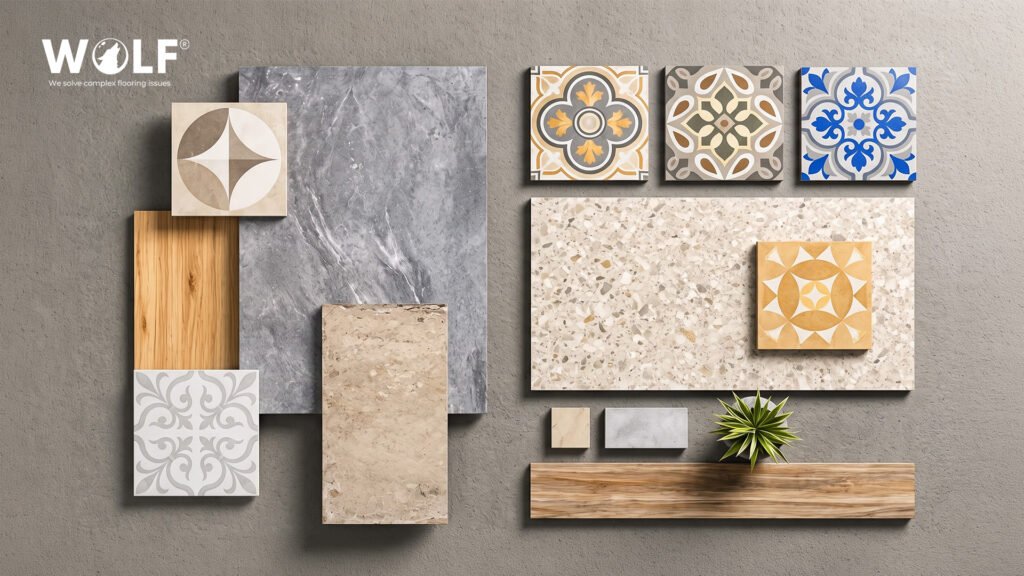
Before you go further, get clear on per-SKU minimum order quantities, whether mixed-size loads are possible within one container, and payment terms including deposit percentage and balance timing. This is also where you start thinking ahead to what you’ll actually stock, which we cover properly in the follow-up guide onwhat to stock in Serbia. Browse the full range inWolf’s collections.
Step 5: Confirming the order with your porcelain tile exporter in India
Once specifications are locked, four things need to happen before the container gets sealed:
Proforma invoice – Confirms quantities, sizes, pricing and terms in writing before any deposit moves.
Deposit. Usually a percentage upfront, with the balance due before or against shipping documents depending on the terms agreed.
Pre-shipment inspection – A check on the finished goods before loading, either by you, an agent, or the factory itself with photo or video evidence.
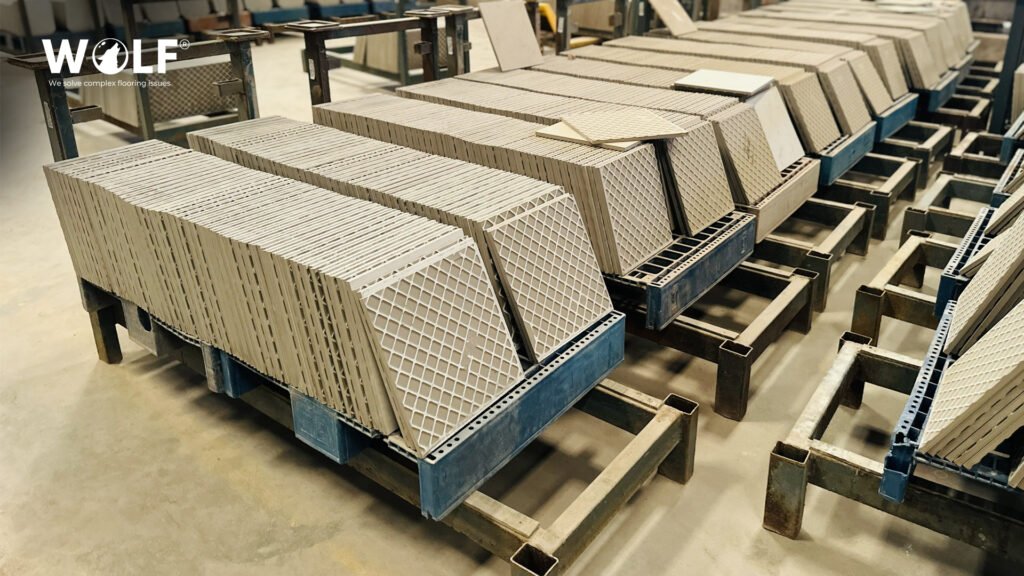
Batch sign-off – Final confirmation that the batch matches the approved sample, since shade can shift slightly between production runs.
Batch sorted pallets, ready for pre-shipment inspection before the container is sealed
Wolf handles this stage through a dedicated point of contact rather than a general sales inbox, so nothing gets lost between confirming the order and the container actually shipping.
Step 6: Shipping porcelain tiles from India to Serbia through Rijeka
Serbia doesn’t have its own coastline, so every container comes in through a neighbouring country’s port and then travels inland. Four gateways compete for the business, and the right one depends on where your warehouse sits, not which quote looks cheapest on paper.
Rijeka – The default for most Serbian importers. It handles the bulk of the country’s trade and has a direct rail link to Belgrade, which is where most demand sits.
Koper – Works on the same logic as Rijeka and is worth quoting alongside it rather than picked blind, since space and schedules shift between the two.
Thessaloniki into Niš – Makes sense if you distribute out of southern Serbia. The rail link on Corridor X can be shorter from there than hauling everything back down from Belgrade.
Bar – Road-served, which suits smaller loads where the schedule matters more than shaving a bit off the per-container cost.
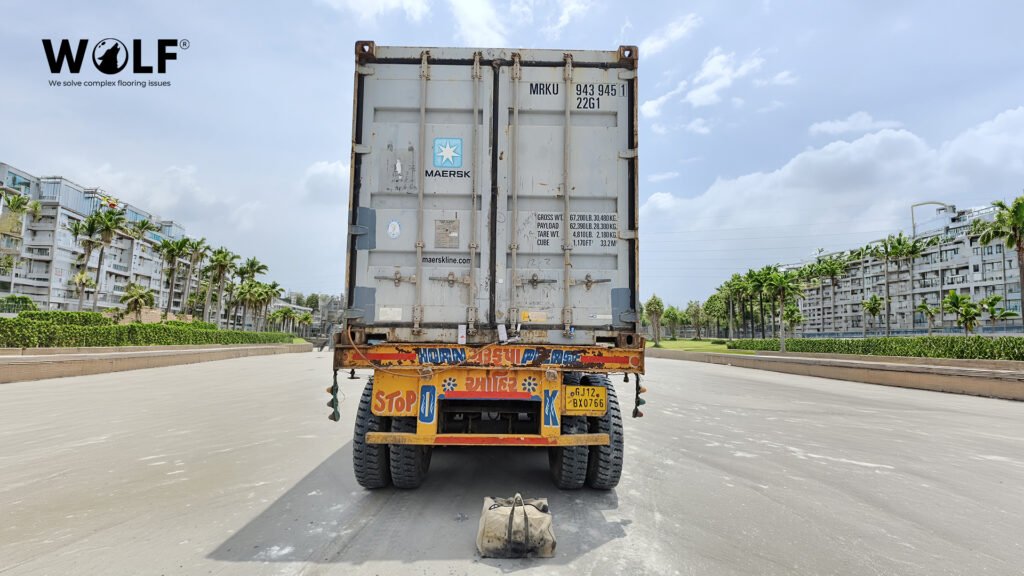
A sealed container on its way out, headed for Rijeka before the rail leg to Belgrade
Picking a port purely on freight price and ignoring the inland leg is exactly how a cheap quote turns into an expensive landed cost. Wolf plans consolidation around the gateway you’ll actually clear through, see thecontainer loading guide for how that works.
Step 7: Tile import duty in Serbia, and why EU anti-dumping does not apply
Serbia sits outside the EU customs union and sets its own tariff. Since India and Serbia don’t have a trade agreement between them, MFN rates apply. Serbia’s simple average MFN rate across all goods sat around 7.3% in 2024, with most categories landing somewhere in the 0-30% range. We haven’t been able to confirm the exact line-level rate for HS 6907, porcelain tiles specifically, from a source we’d stand behind, so treat that 7.3% as the honest all-goods average, not a tile-specific number. Duty is calculated on the customs value, which is CIF based. Serbian distributors researching this often search it as porcelanske pločice uvoz iz Indije, the same question phrased in the local language.
Here’s the part that changes the maths. The EU charges an anti-dumping duty of 6.7% to 8.7% on Indian ceramic tiles, on top of the regular customs duty. Serbia sits outside the EU customs territory, so that duty does not apply here at all. Put a number on it: on every €100,000 of CIF value, a buyer inside the EU pays somewhere between €6,700 and €8,700 just in anti-dumping duty. And because EU import VAT is charged on the customs value plus all duty, an EU buyer also funds VAT on top of that anti-dumping amount at clearance, so the cost compounds twice before the container even reaches the warehouse. OurCroatia landed-cost breakdown walks through exactly what that looks like for a buyer in Zagreb. A Serbian distributor buying the same container from the same Morbi factory funds neither. On a full container programme, that gap adds up fast.
To be fair about it, being outside the EU cuts both ways. Serbia also sits outside the India-EU FTA concluded in early 2026, so whatever duty relief eventually lands for EU buyers around 2027 won’t reach Serbian importers either. Getting the HS classification right and knowing your producer’s specific standing up front means the duty line is correct from the start, which is where Wolf’s documentation comes in.
Step 8: Import VAT in Serbia, and customs clearance
Serbian import VAT sits at a standard 20%. The base for that calculation isn’t your invoice value, it’s the customs value (CIF based) plus the customs duty and any other import charges, so whatever you land on in Step 7 directly moves the VAT number too.
If you’re VAT-registered, this comes back through your periodic return, so it’s a cash flow timing cost rather than a permanent one. You still need to fund it at the point of clearance though. You’ll need a Serbian EORI number and registration with the Customs Administration. SEF e-invoicing has been mandatory for B2B transactions since January 2023, and e-delivery notes started phasing in from January 2026, extending across all private-sector B2B by October 2027.
Wolf prepares a full clearance-ready document pack for every shipment: invoice, packing list, certificate of origin and HS classification, so a paperwork gap doesn’t hold up your container at a non-EU border where mistakes cost more than they would inside the EU.
Importing porcelain tiles from India to Serbia with Wolf
One manufacturer, consistent grade across every tier and every reorder. Whether this is your first container or you’re building toward a standing range across the region, one accountable supplier is what makes that plannable. If you’re still weighing India against other sourcing markets, theIndia vs China vs Turkey comparison covers that ground. Once you know what to bring in, the next question is what actually sells, which is what we cover inwhat to stock in Serbia.
FAQ : How to Import Porcelain Tiles from India to Serbia
Order container quantities directly from a Morbi manufacturer, ship through Rijeka, Koper, Thessaloniki or Bar, and clear Serbian customs with an EORI registration. Duty applies to the customs value at Serbia's MFN rate, and 20% VAT is charged on that customs value plus the duty.
Serbia sets its own tariff and applies MFN rates to India, since there's no trade agreement between the two countries. Serbia's average MFN rate across all goods sat around 7.3% in 2024. The EU anti-dumping duty on Indian ceramic tiles doesn't apply here, since Serbia sits outside the EU customs territory.
Containers from India reach Serbia through a neighbouring seaport and then travel inland by rail or road. Rijeka is the main gateway with rail to Belgrade, Koper is the common alternative, Thessaloniki connects by rail to Niš, and Bar is served by road.
Serbian import VAT on tiles is 20%, charged on the customs value, which is CIF-based, plus customs duty and any other import charges. A VAT-registered distributor can recover it, so it functions as a cash flow cost funded at clearance rather than a permanent one.
Minimum order quantities from a Morbi manufacturer are usually set per SKU rather than per full container, which allows mixed-size loads as long as each individual size clears its own minimum.
Get 3 Free Samples for Your Serbia Import + a cost sheet