




If you sell tile to German contractors, you know this email.
The price is agreed. The format’s right. Then, before anyone has even seen a pallet, a request comes in for the Declaration of Performance, the test reports, slip certificates for the exact finish, and batch and shade records. Sometimes all four arrive in one message, numbered.
Suppliers outside Germany tend to read that as bureaucracy. Spend some time with German Fliesenleger and you’ll hear a different explanation. The installer is the one who stays answerable for that floor for years after the invoice is paid. Every document on that list is a piece of evidence they might need later.
This Germany tile import compliance checklist is written for distributors and specifiers who supply those contractors. It explains why the checks happen and what to have on file before your container leaves Morbi. The standards themselves get a quick summary only. If you want the full technical breakdown, our Croatia porcelain tile compliance checklist covers it properly.
It comes down to contract law.
Public construction in Germany runs on VOB/B (the contract terms within the Vergabe- und Vertragsordnung für Bauleistungen), and a lot of commercial work uses it as well. Under VOB/B, the contractor’s liability for defects in building work (Gewährleistung, in everyday language) lasts four years from Abnahme, the formal handover. If VOB/B isn’t part of the contract, the German Civil Code applies and that period is five years.
There’s also a detail that catches suppliers out. Under VOB/B, if the client sends a written defect notice before the period ends, the clock for fixing that defect runs for two more years from the date of the notice. So a floor laid in 2026 can still be in dispute in 2031.
Now think about who is exposed. The Fliesenleger laid the tile and signed off the job. If a defect shows up, they have to come back and fix it. If the defect traces back to the tile itself, German sales law allows the cost of taking it up and relaying it to be passed back to whoever sold that tile. That’s you, the distributor. What you can then recover from your own manufacturer depends on what your purchase contract says, so read it carefully. (This is general information, not legal advice. For anything contract-specific, talk to a German Baurecht lawyer.)
Seen this way, the documents are how the contractor proves the tile was right when it arrived. That’s why German buyers audit them so closely.
Porcelain tiles sold in the EU carry CE marking against the harmonised standard EN 14411, and every CE-marked product needs a Declaration of Performance (DoP) from the manufacturer. The DoP states the declared values. When a buyer checks CE marking on tiles for a Germany import, they’re looking at two things. Does the DoP match the product being shipped? And are the values on it backed by test reports? A generic DoP covering “all porcelain” is a red flag.
The full breakdown of what a valid DoP contains is in our Croatian importer’s compliance guide.
For EN 14411 porcelain tiles in Germany, the classification to look for is group BIa, meaning water absorption of 0.5% or less. That figure tells you the tile body is dense and suitable for porcelain applications. It says nothing about slip resistance, shade or the batch you’re about to receive, so treat it as the starting point.
We go through the full EN 14411 classification table in the Croatia checklist.
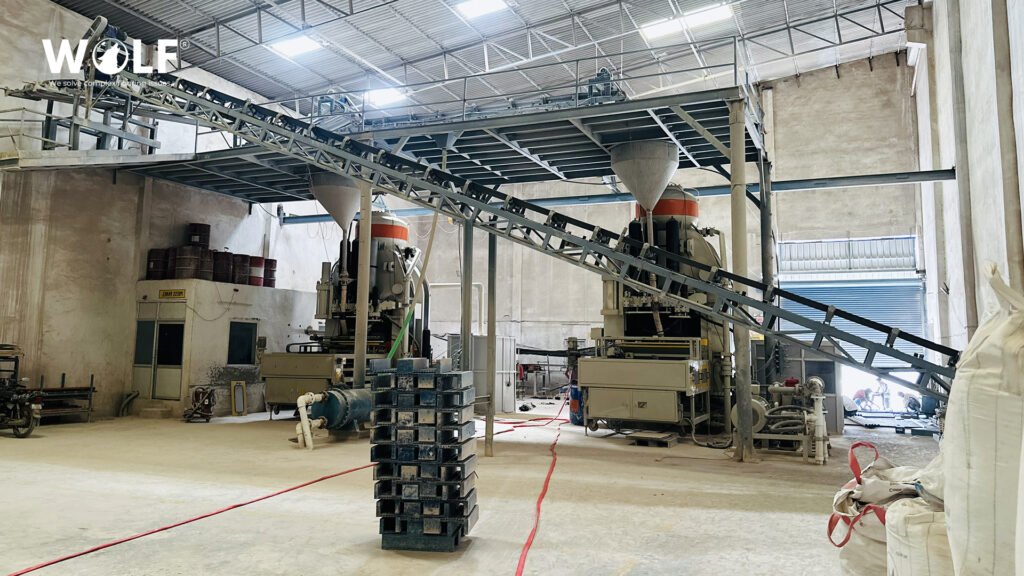
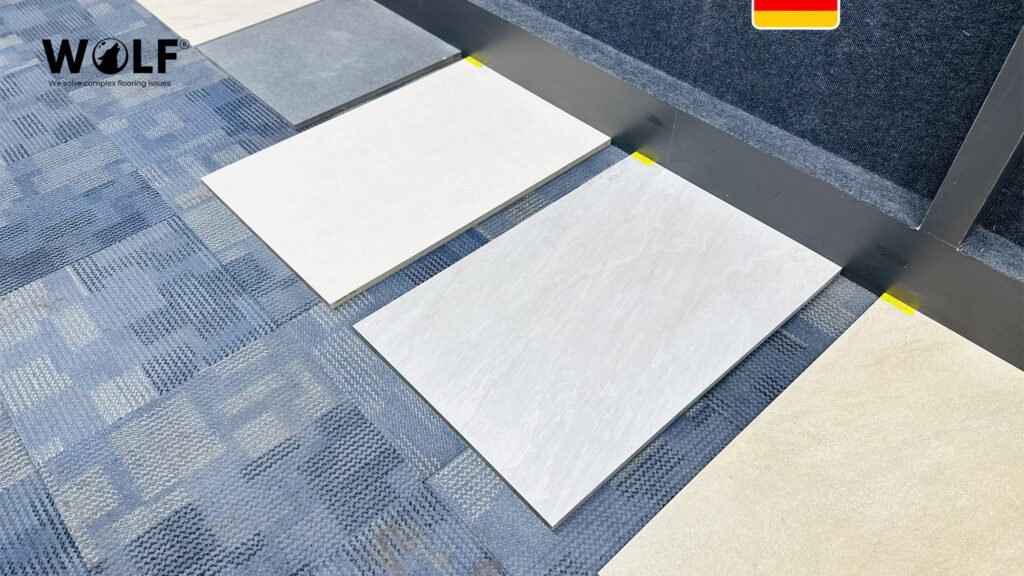
German buyers will ask for DIN 51130 (R9 to R13, for shoe-worn workplace floors) and DIN 51097 (classes A, B and C, for barefoot areas such as pool surrounds and changing rooms). Make sure the certificate matches the finish you’re actually shipping. A matte and a polished version of the same design can test very differently, and a slip certificate for the wrong surface is worthless on site.
The complete R and A/B/C rating tables are in our Croatia compliance checklist.
This section matters more than any other in this guide.
Picture a 400 m² office job. The first delivery is laid in the open-plan area. The second arrives three weeks later and goes into the corridor. Under the site lighting the corridor tiles look a shade warmer. Nobody notices until Abnahme, or until the client walks through on a sunny afternoon six months later.
And yes, a visible shade difference can count as a defect. On a VOB job, that’s the contractor’s problem to fix. Their first question will be which batch went where, and whether anyone was told the deliveries were different.
This is what VOB tile documentation in Germany really comes down to. If every box carries a batch number, shade code and calibre, and the packing list maps those to each pallet, that question has an answer. If not, it turns into an argument, and the person with the weakest paperwork usually ends up paying.
That’s why experienced German buyers want this information up front:
In effect, the buyer is paying for that paper trail along with the tile.
→ With Wolf: batch and shade documentation comes with every order as standard. You don’t have to ask for it after a claim.
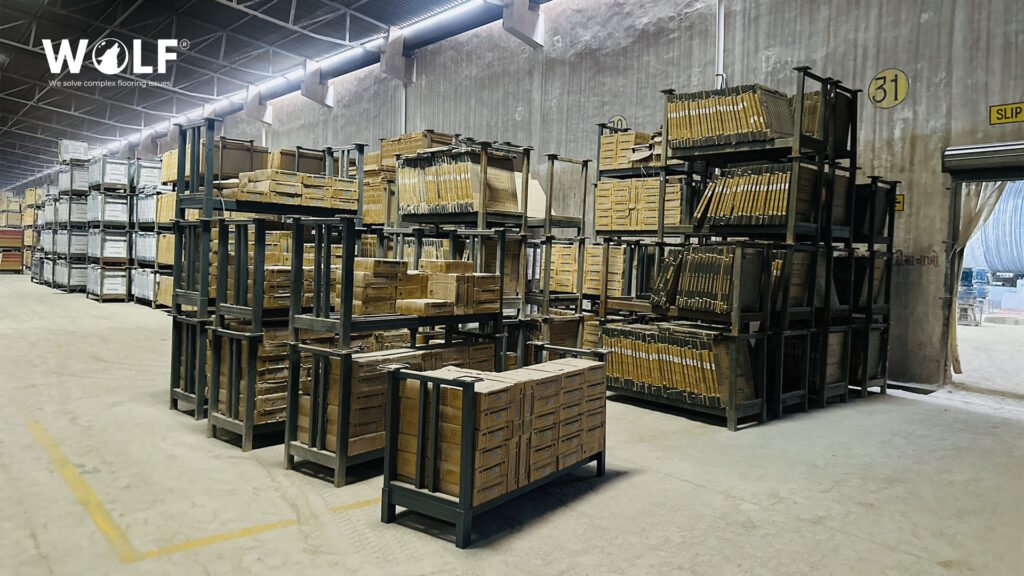
Before the container ships, these should already be on file:
When you check test reports from a Morbi tile manufacturer, look at three things. Is the report for this product and this finish? Is it recent? Did an accredited lab issue it? Ask for everything before shipment. Once the goods are on the water, your leverage is mostly gone.
→ With Wolf: the full test-report pack is available with every order. You can see the markets we already ship to on our Wolf export capability page, and you can request a sample and test reports before you commit to a container.
Supplying a German contractor this quarter? Get 3 free samples plus the test-report pack and check them against this list before you place the order. Request samples
Renovation is growing fast in Germany. According to the Greyfield Index 2026, around 44% of German construction activity now takes place in existing buildings. In Bremen, Hesse, NRW, Saarland and Thuringia, work on existing buildings has already overtaken new buildings.
For tile, that means more requests to match an existing floor: a second phase, an extension, or replacing a damaged section in an occupied building. Batch matching used to be an unusual request. Now it comes up all the time, and every one of those jobs depends on the documentation trail described above.
What this means for your stock plan is covered in our guide on what to stock in Germany.
Save this one and send it to your supplier before you sign anything.
If you’re searching in German, Fliesenimport Deutschland Konformität (tile import compliance for Germany), those nine points are the answer.
Your contractor customer needs a supplier whose paperwork stands up if there’s ever a dispute. With Wolf, batch and shade records and the full test pack come with the order, so you can pass a complete file straight to the installer.
Still comparing sourcing countries? Our India vs China vs Turkey supplier comparison covers compliance track records and landed cost, and our breakdown of the India–EU trade deal explains what it does and doesn’t change on duties.
Once your documentation is in order, the next question is stock. We cover what to stock for German renovation demand in the next guide.
CE marking with a Declaration of Performance, EN 14411 classification, DIN slip-rating certificates for the intended use, and batch and shade documentation traceable to the production run.
EN 14411 is the European standard for ceramic tiles. It classifies porcelain as group BIa (water absorption ≤0.5%) and is the baseline technical standard across the EU, including Germany.
Contractors on German building jobs stay liable for defects after handover: four years under VOB/B where it's agreed, five years under the German Civil Code otherwise. Visible shade inconsistency can count as a defect, so batch records protect the contractor long after installation.
Water absorption, modulus of rupture, frost resistance and slip-rating test reports, along with the Declaration of Performance and batch and shade records for the specific production run.
Pick three tiles and tell us your sizes and where your stock ends up. We’ll send the samples with an Antwerp-Bruges landed-cost sheet worked out on your volume.
No spam, no obligation.